modular fiasco
Node based DAW & VST / AU Plugin
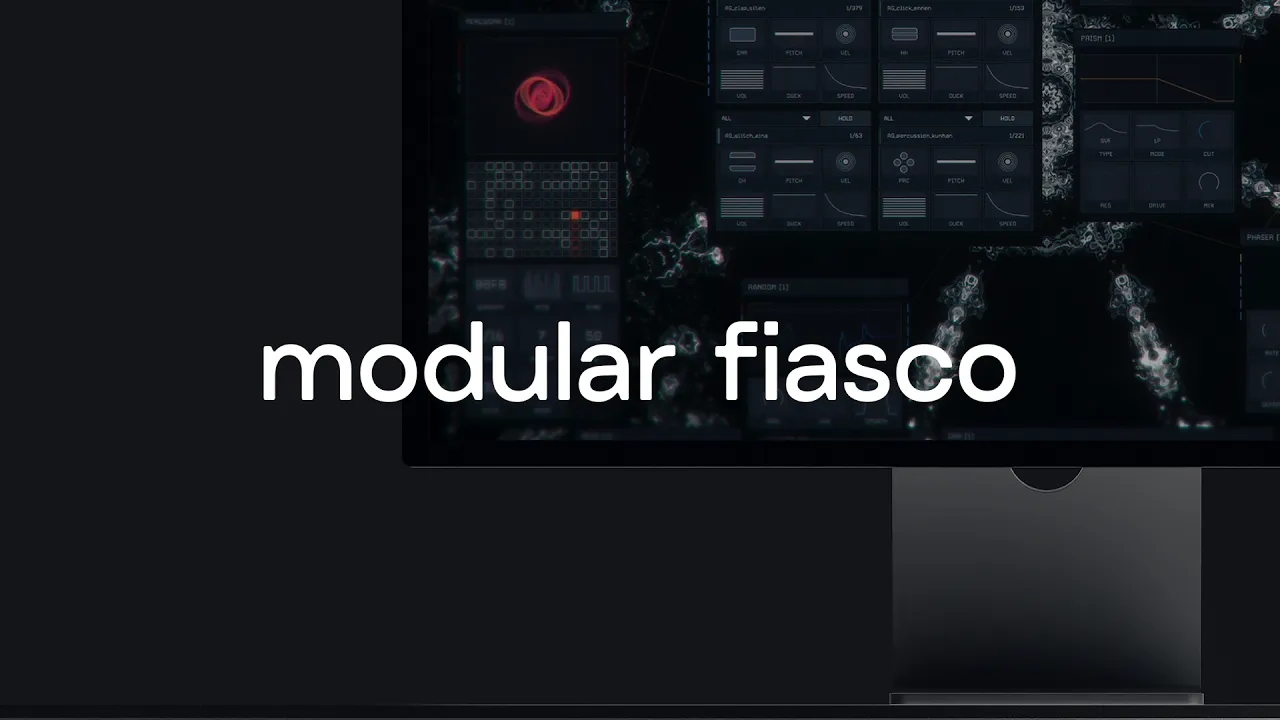
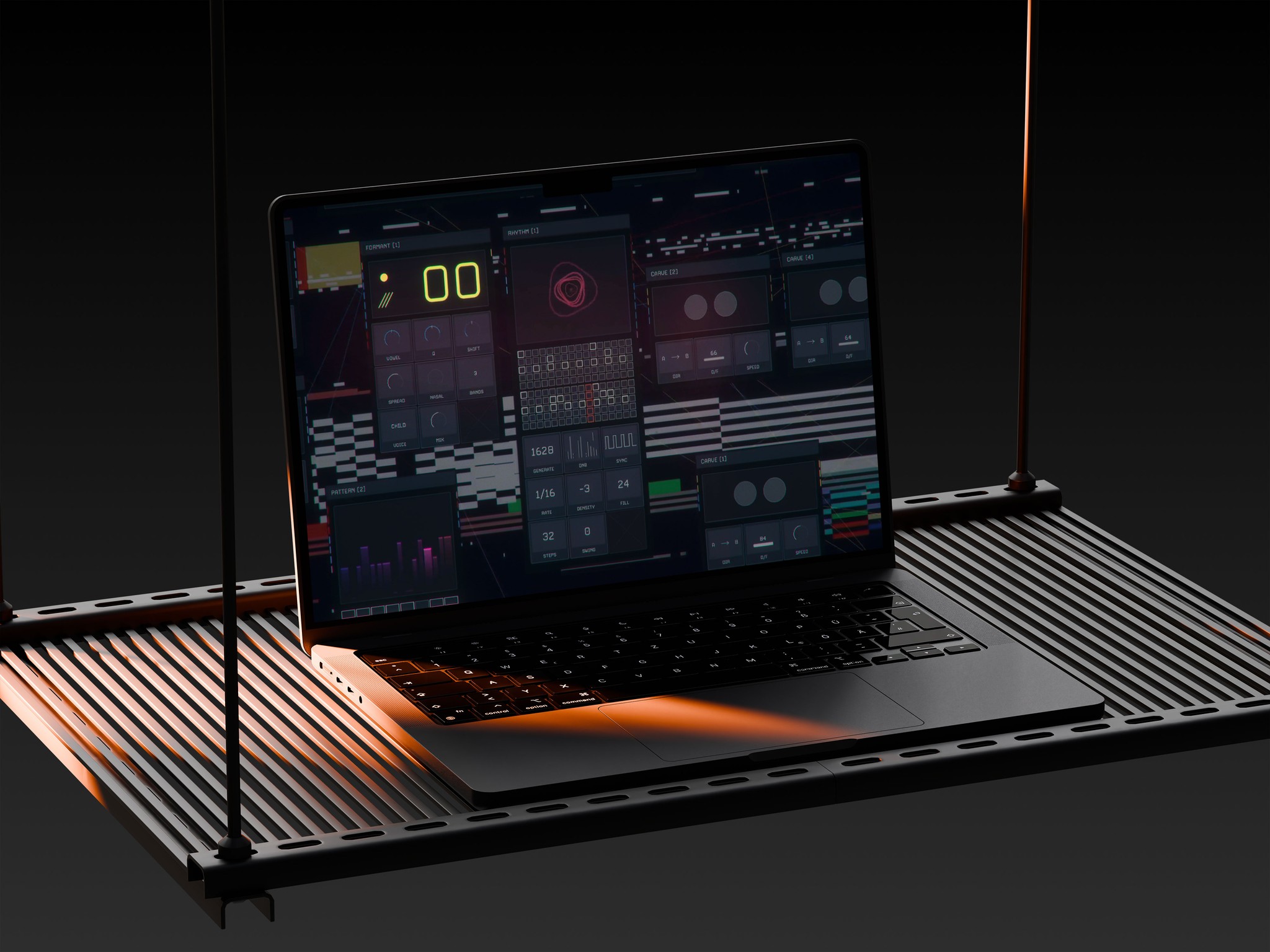
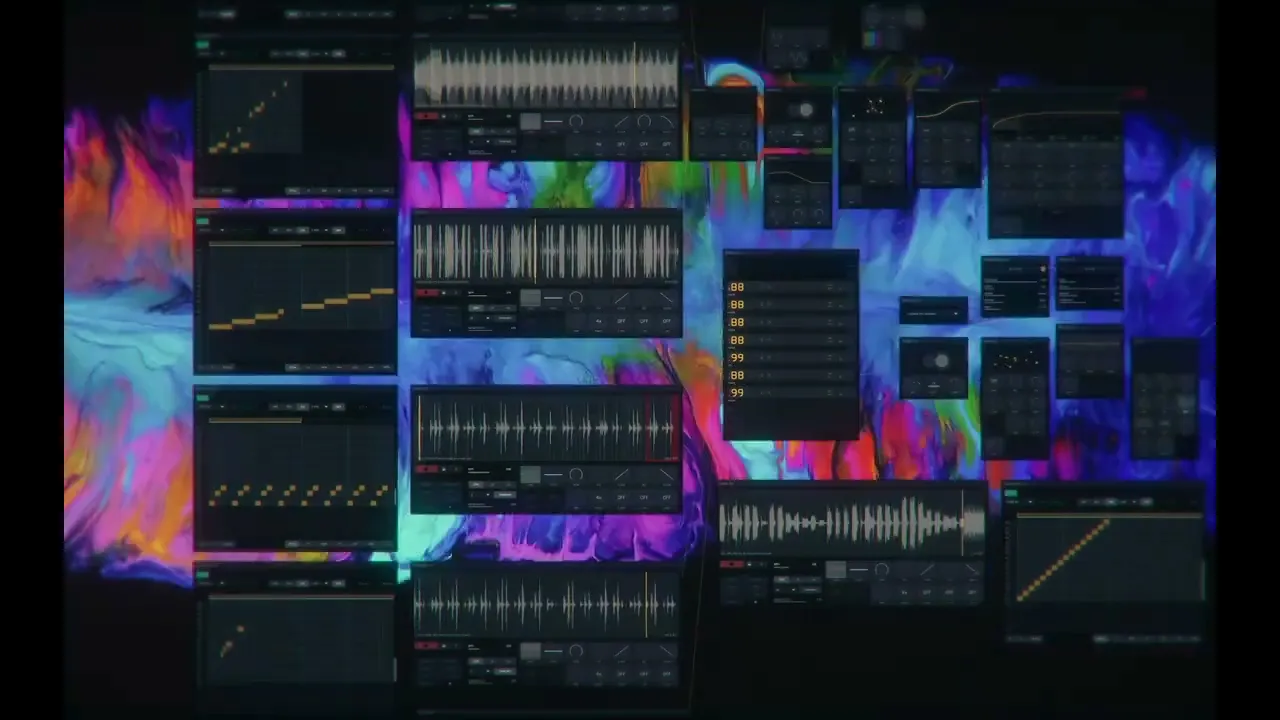
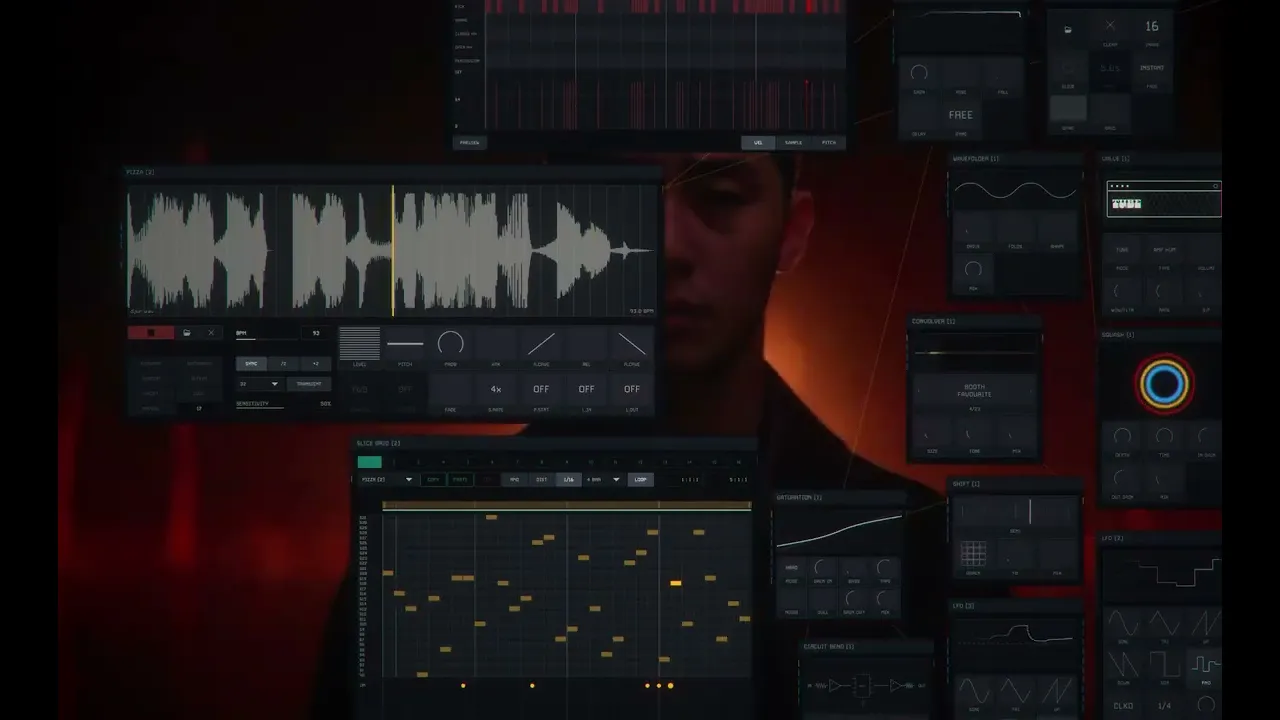
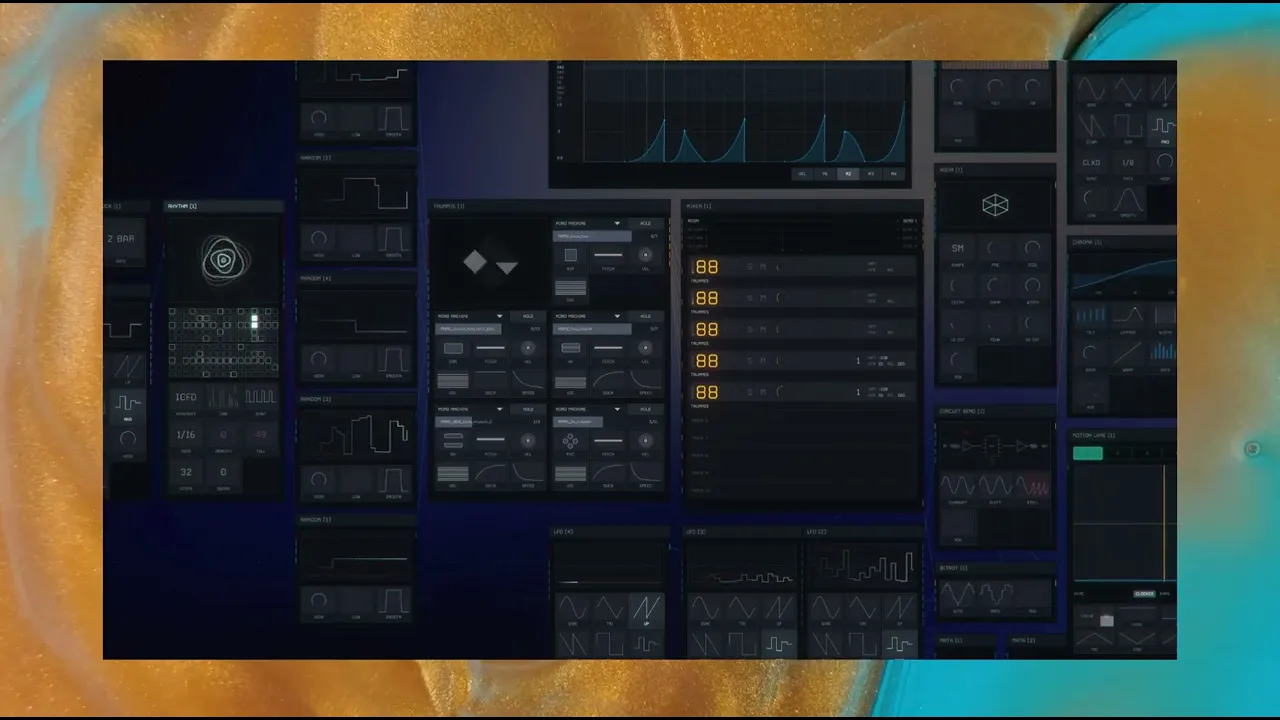
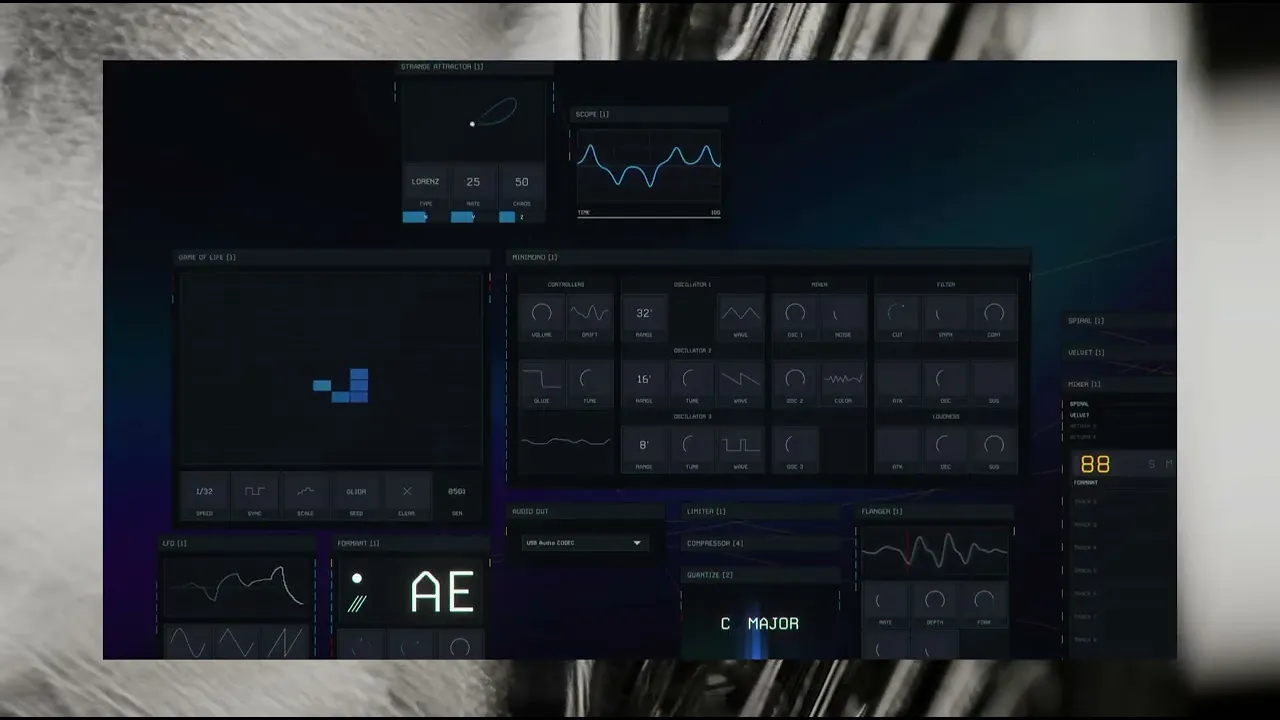
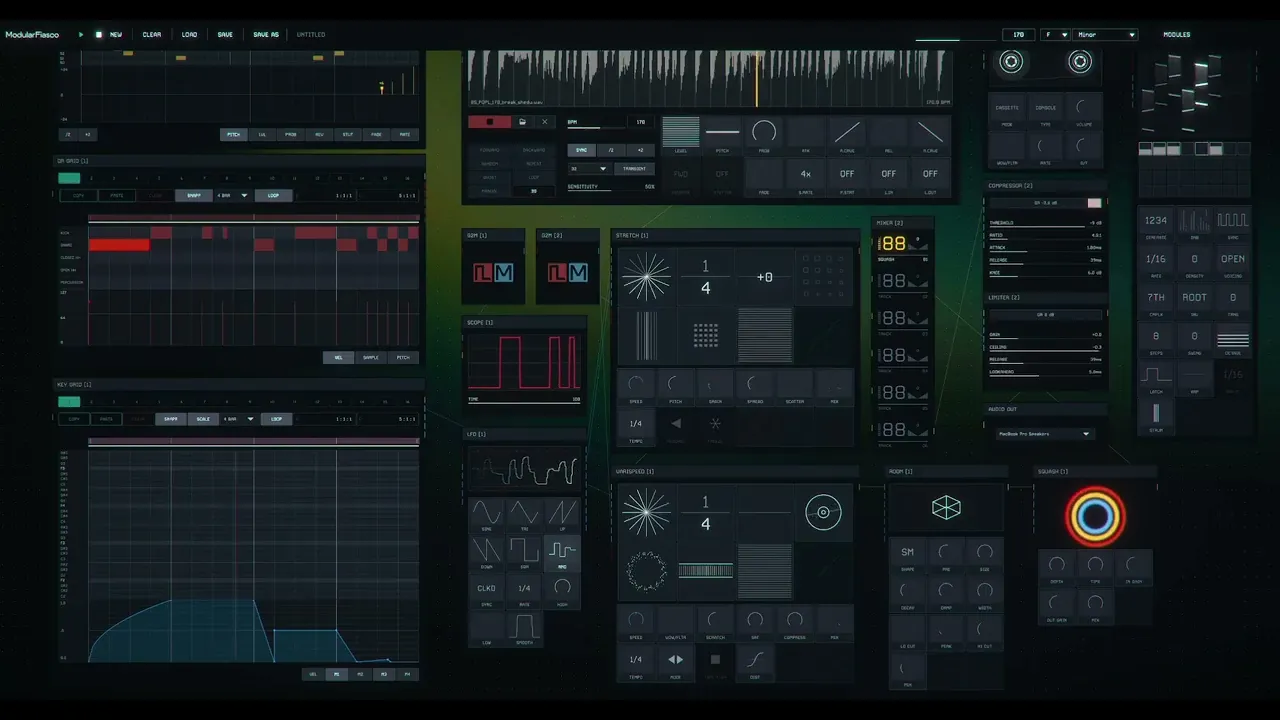
Modular Fiasco is a node-based modular DAW that runs both as a standalone and as a plugin inside your existing DAW. Acting as a synth, drum machine, sampler, slicer, sequencer, FX chain, or all of the above at once.
Modular Fiasco is for producers and sound designers who want total control over signal flow without being locked into a traditional linear DAW. If you're into modular synthesis, node-based workflows, or just want something that breaks the rules, this is it. Route everything, modulate everywhere.

Generative Sequencers
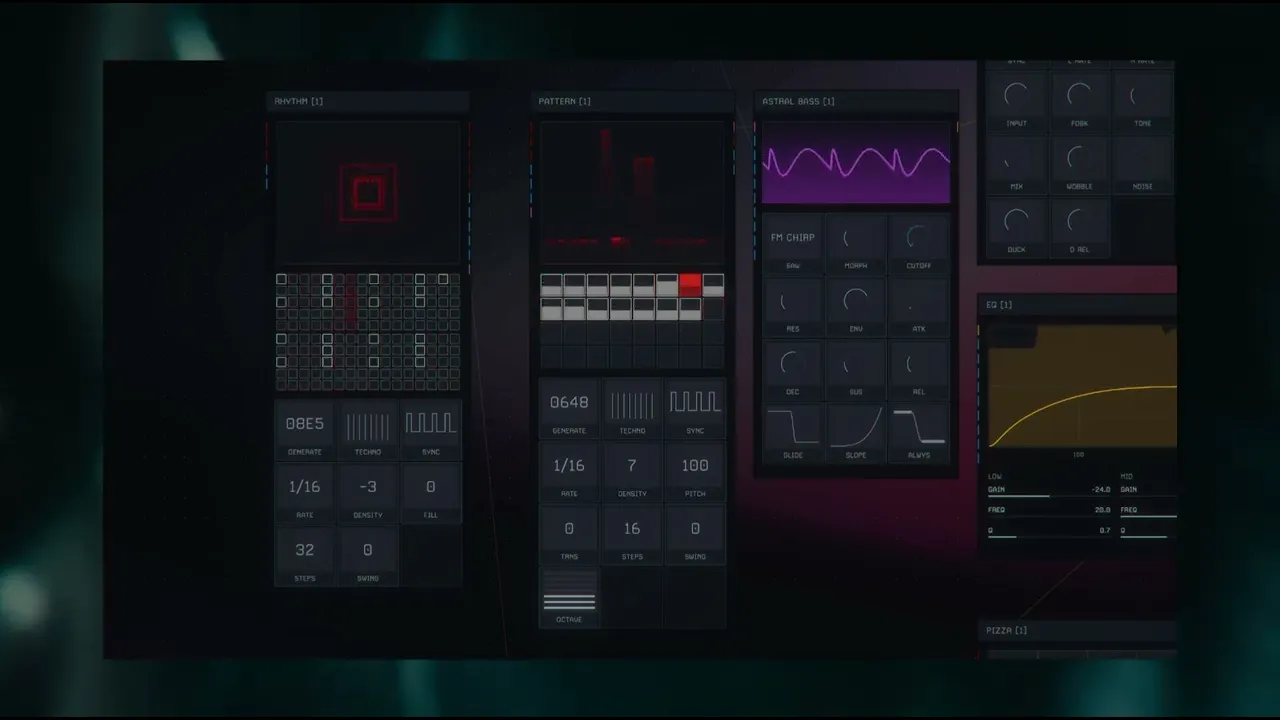
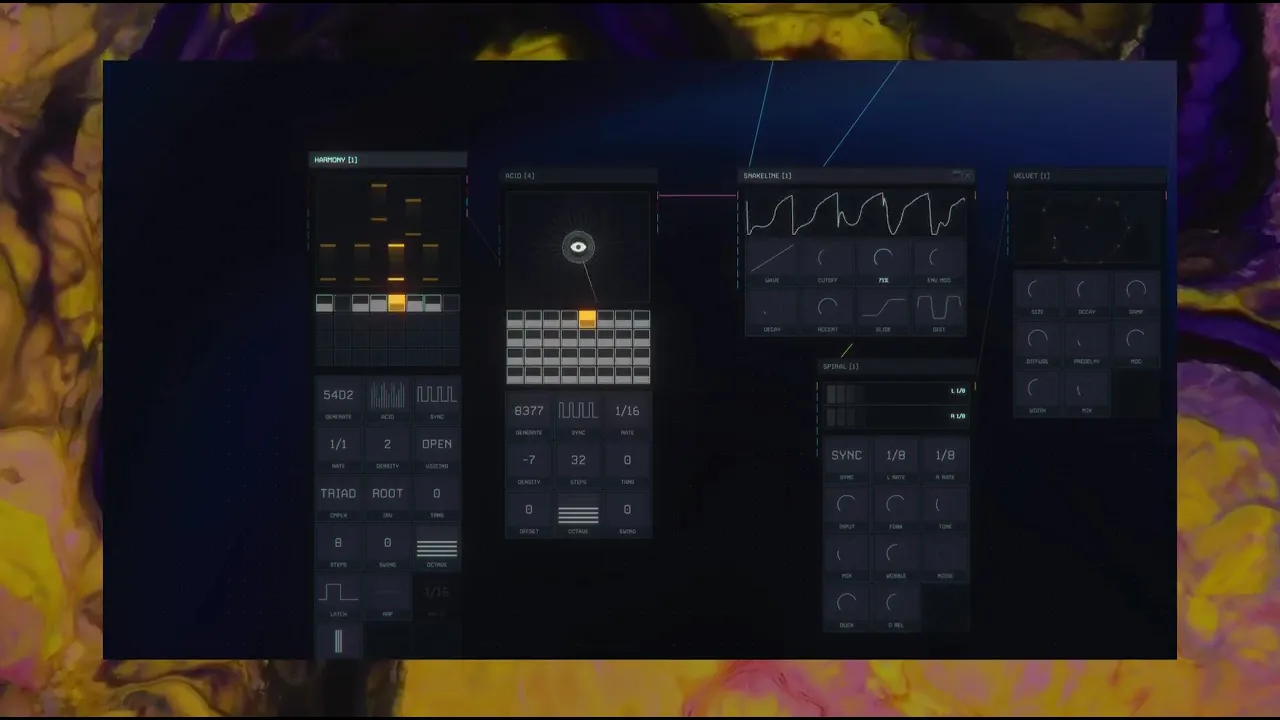
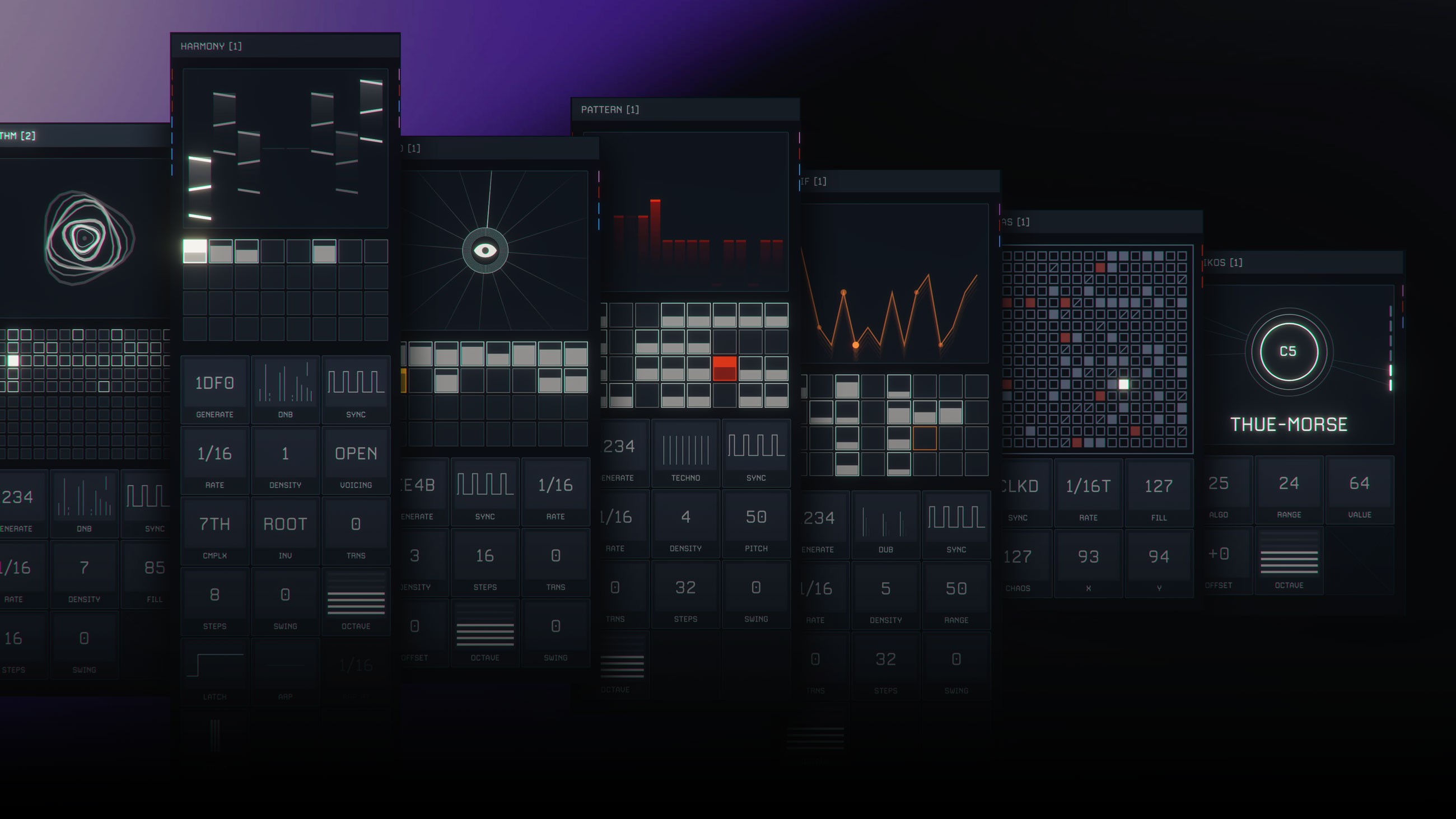
Modular Fiasco includes a family of generative sequencers that can produce complete musical arrangements with minimal setup. These modules share a common design language: genre selection, seed-based randomization, clock sync, and swing, so they work together seamlessly. Feed them a clock and they'll start spitting out musically coherent content immediately.
PATTERN: Genre-shaped pitched patterns for bass synths and leads.
MOTIF: Memorable melodic cells with repetition and variation.
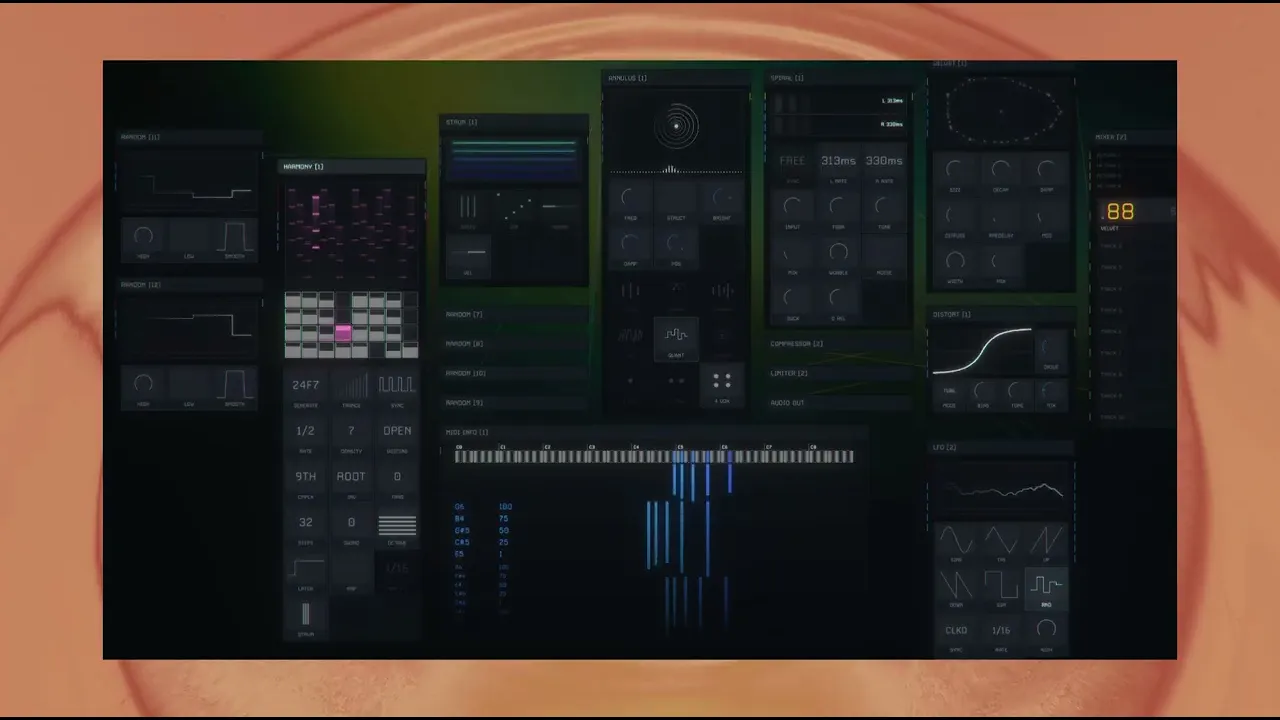
HARMONY: Multi-note chords, root CV, bass voice, built-in arp and Strum.
RHYTHM: Kick/snare/hihat/openhat/perc with velocity per voice.
ACID: TB-303-flavored patterns with slide and accent.
APRIKOS: 34 algorithms from random walk to L-systems to cellular automata.
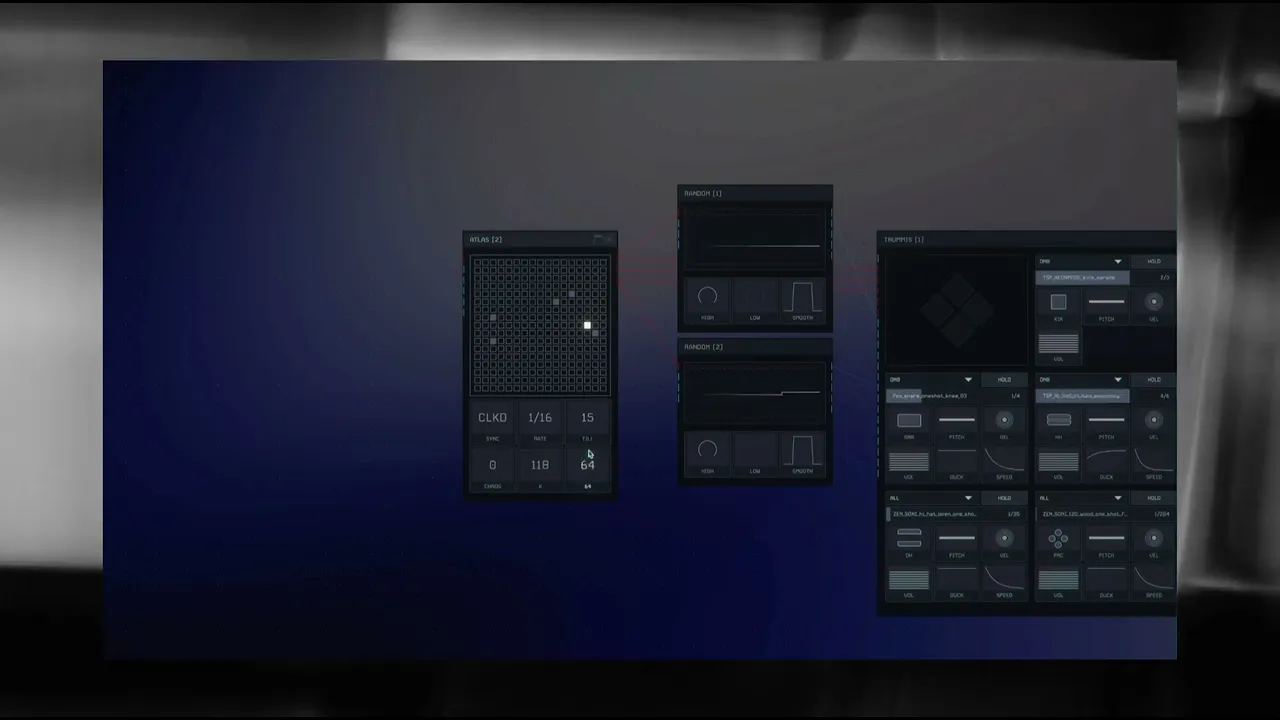
ATLAS: Step-by-step drum patterns with velocity control.
Generative Sequencers
Modular Fiasco includes a family of generative sequencers that can produce complete musical arrangements with minimal setup. These modules share a common design language: genre selection, seed-based randomization, clock sync, and swing, so they work together seamlessly. Feed them a clock and they'll start spitting out musically coherent content immediately.
PATTERN: Genre-shaped pitched patterns for bass synths and leads.
MOTIF: Memorable melodic cells with repetition and variation.
HARMONY: Multi-note chords, root CV, bass voice, built-in arp and Strum.
RHYTHM: Kick/snare/hihat/openhat/perc with velocity per voice.
ACID: TB-303-flavored patterns with slide and accent.
APRIKOS: 34 algorithms from random walk to L-systems to cellular automata.
ATLAS: Step-by-step drum patterns with velocity control.
Step Sequencers
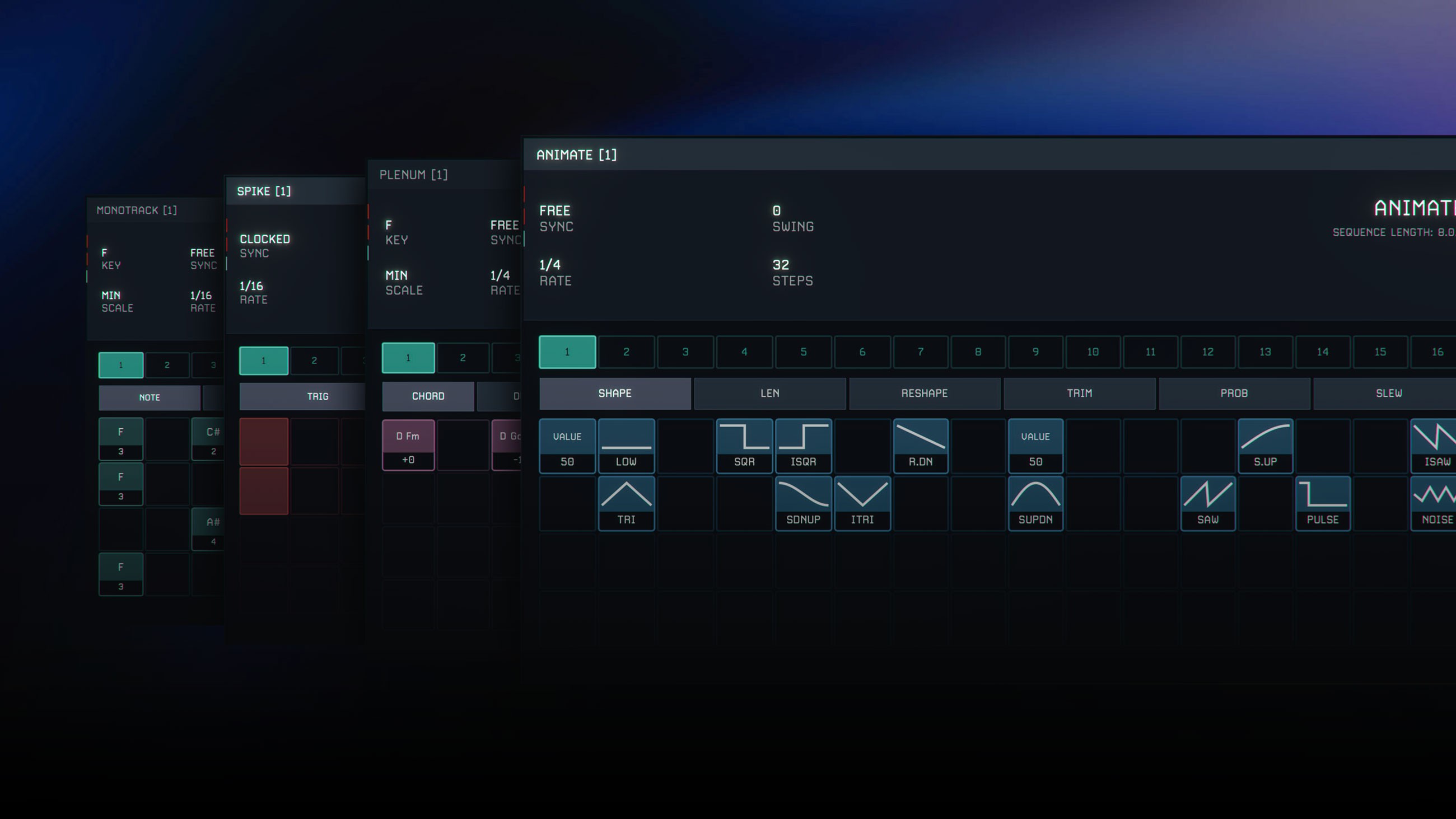
Where the generative modules create content for you, step sequencers let you program it by hand note by note, step by step. These are for when you know exactly what you want and need precise control over every hit, note, or modulation shape.
PLENUM: Polyphonic chord sequencer with 20 mood palettes, arp, strum.
MONOTRACK: Single-voice pitch sequences, step by step.
ANIMATE: Per-step waveform shapes (20 types) for parameter automation.
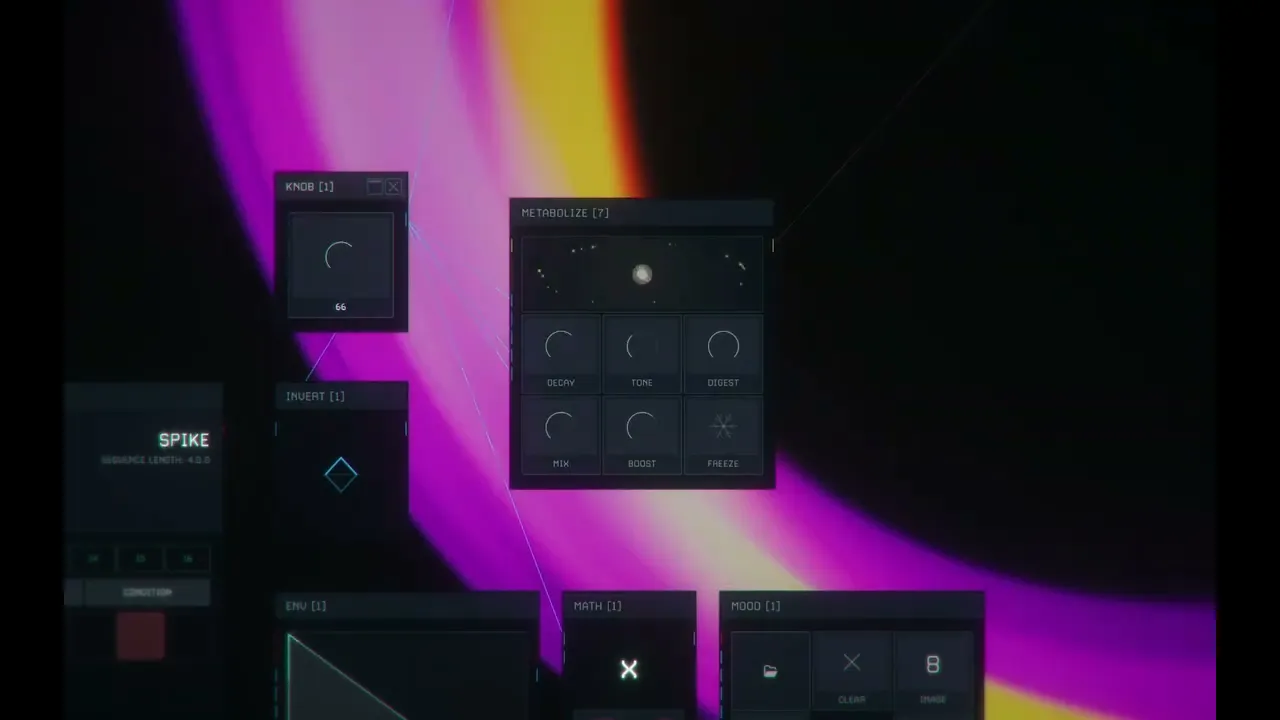
SPIKE: Complex gate patterns with ratchets, probability, and duration.
PLENUM is the heavyweight. A polyphonic chord sequencer with 20 mood palettes that define the harmonic character, plus per-step control over chord type, velocity, strum, and arpeggio style. Think of it as the manual counterpart to HARMONY. MONOTRACK is the simplest of the bunch. A straightforward monophonic step sequencer for bass lines and leads where you just want to punch in notes. ANIMATE sequences CV shapes instead of notes. Each step outputs a waveform (sine, triangle, saw, etc.) making it a programmable modulation source that stays locked to the beat. SPIKE is the trigger specialist with 5 edit modes (trigger, duration, length, ratchet, probability) across up to 64 steps. When you need drum fills, rolls, or evolving gate patterns, this is the one.
All four support 16 patterns and CONDUCTOR linking, so you can arrange different patterns across song sections.
Step Sequencers
Where the generative modules create content for you, step sequencers let you program it by hand note by note, step by step. These are for when you know exactly what you want and need precise control over every hit, note, or modulation shape.
PLENUM: Polyphonic chord sequencer with 20 mood palettes, arp, strum.
MONOTRACK: Single-voice pitch sequences, step by step.
ANIMATE: Per-step waveform shapes (20 types) for parameter automation.
SPIKE: Complex gate patterns with ratchets, probability, and duration.
PLENUM is the heavyweight. A polyphonic chord sequencer with 20 mood palettes that define the harmonic character, plus per-step control over chord type, velocity, strum, and arpeggio style. Think of it as the manual counterpart to HARMONY. MONOTRACK is the simplest of the bunch. A straightforward monophonic step sequencer for bass lines and leads where you just want to punch in notes. ANIMATE sequences CV shapes instead of notes. Each step outputs a waveform (sine, triangle, saw, etc.) making it a programmable modulation source that stays locked to the beat. SPIKE is the trigger specialist with 5 edit modes (trigger, duration, length, ratchet, probability) across up to 64 steps. When you need drum fills, rolls, or evolving gate patterns, this is the one.
All four support 16 patterns and CONDUCTOR linking, so you can arrange different patterns across song sections.
Grid Sequencers
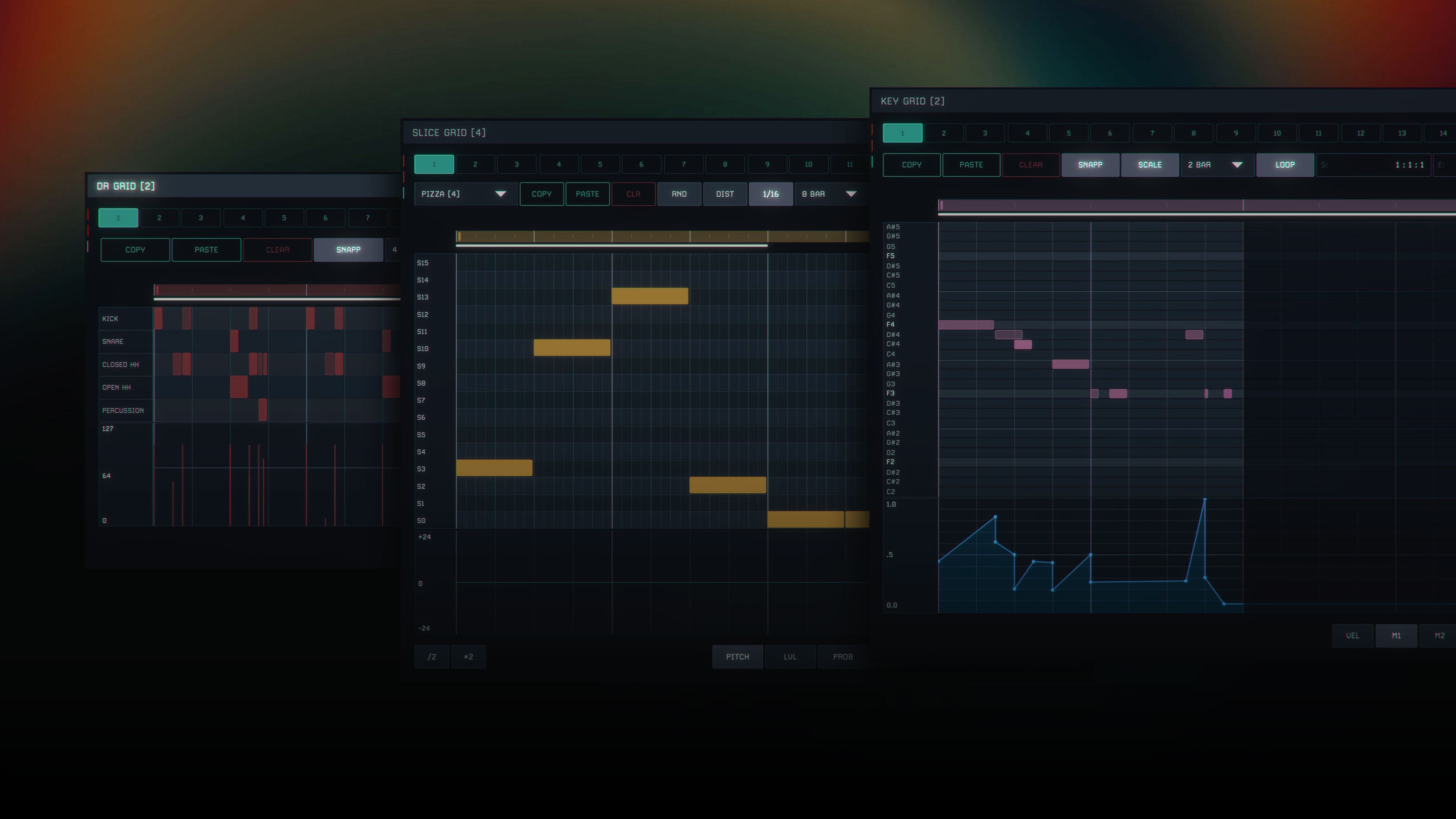
The piano roll / grid editors. Visual DAW-style sequencing where you click to place events on a timeline. These are the most hands-on way to compose in Modular Fiasco, giving you full visual control over timing and placement.
KEY GRID: Notes on a piano roll, with velocity and 4 CV automation lanes.
DR GRID: Per-voice trigger grid for kick/snare/hihat/openhat/perc.
SLICE GRID: Slice events for PIZZA with pitch/level/probability/reverse/stutter per hit.
KEY GRID is the full piano roll. 4 octaves, click to place and drag notes, resize lengths, edit velocity. It also has 4 CV modulation lanes so you can draw parameter automation alongside your melody. DR GRID is the drum equivalent. A 5-voice trigger grid that pairs directly with TRUMMIS, the manual alternative to RHYTHM's generative patterns. SLICE GRID is purpose-built for the PIZZA sample slicer. It programs which slice plays when, with per-event control over pitch, reverse, stutter, and probability for breakbeat-style sample mangling.
All three support 16 patterns with CONDUCTOR linking, snap-to-grid, and loop regions.
Grid Sequencers
The piano roll / grid editors. Visual DAW-style sequencing where you click to place events on a timeline. These are the most hands-on way to compose in Modular Fiasco, giving you full visual control over timing and placement.
KEY GRID: Notes on a piano roll, with velocity and 4 CV automation lanes.
DR GRID: Per-voice trigger grid for kick/snare/hihat/openhat/perc.
SLICE GRID: Slice events for PIZZA with pitch/level/probability/reverse/stutter per hit.
KEY GRID is the full piano roll. 4 octaves, click to place and drag notes, resize lengths, edit velocity. It also has 4 CV modulation lanes so you can draw parameter automation alongside your melody. DR GRID is the drum equivalent. A 5-voice trigger grid that pairs directly with TRUMMIS, the manual alternative to RHYTHM's generative patterns. SLICE GRID is purpose-built for the PIZZA sample slicer. It programs which slice plays when, with per-event control over pitch, reverse, stutter, and probability for breakbeat-style sample mangling.
All three support 16 patterns with CONDUCTOR linking, snap-to-grid, and loop regions.
Sequencing Tools
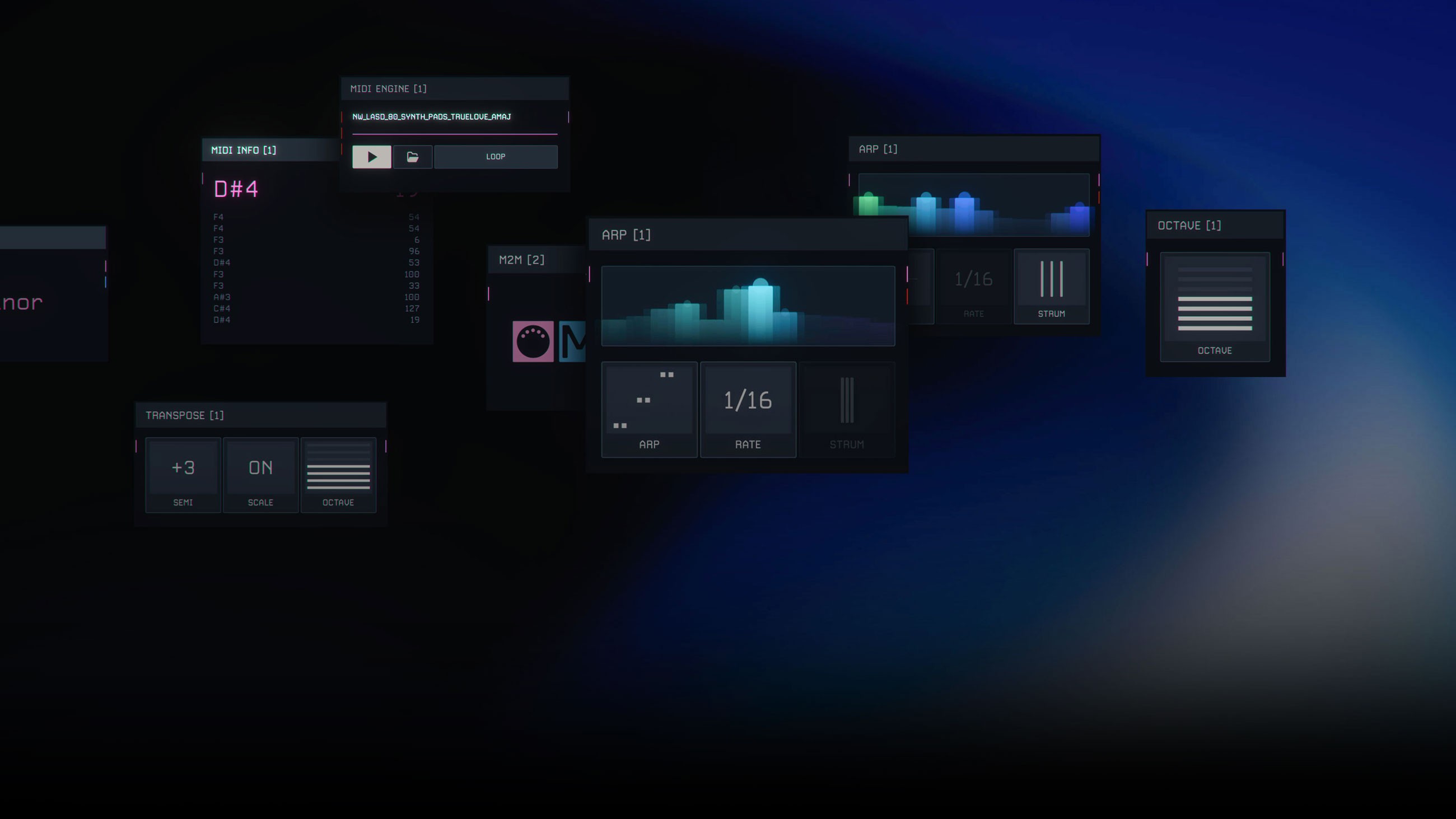
Utility modules that transform, route, monitor, and convert MIDI signals. These sit between your sequencers and synths to shape the musical data before it reaches a sound source.
ARP : Turns held chords into arpeggiated patterns, 11 modes, tempo-synced. Strum function.
MIDI MERGE: Merges two MIDI streams into one output.
MIDI TO MOD: Splits MIDI into Gate + Pitch CV + Velocity CV.
MIDI ENGINE: Loads and plays back .mid/.midi files.
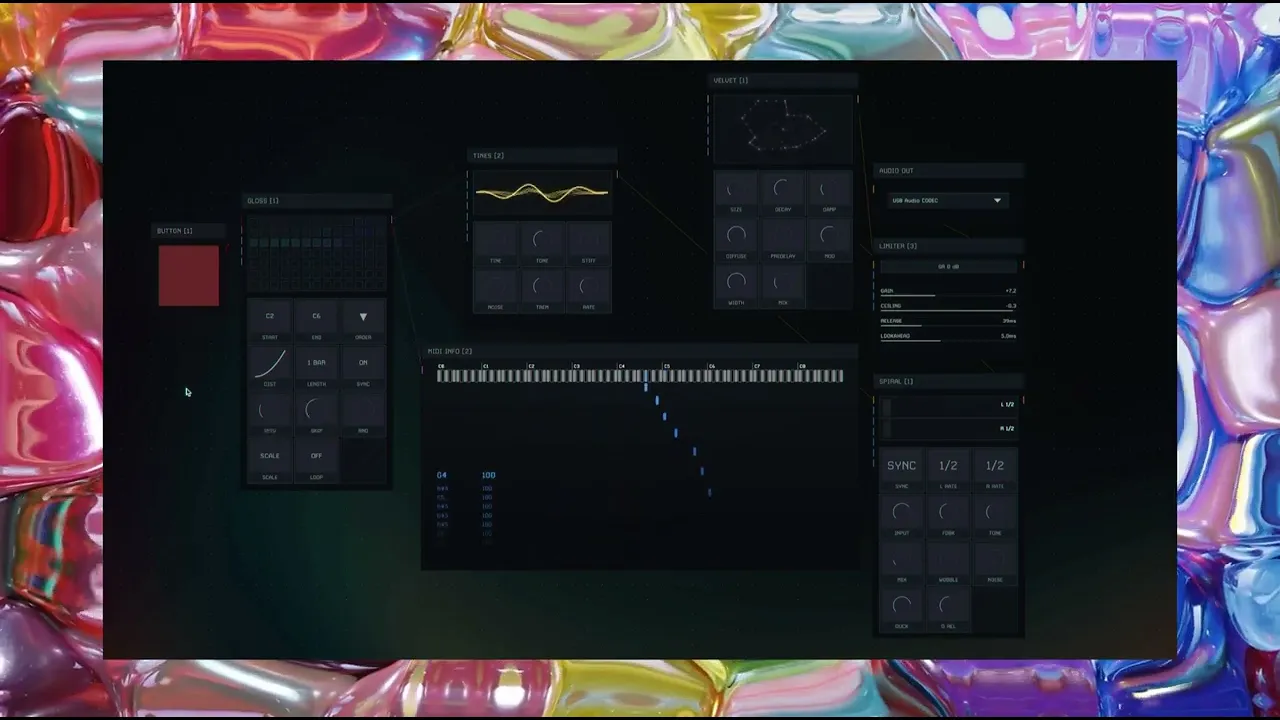
MIDI INFO: Displays incoming note names and velocities in real-time.
OCTAVE: Shifts all notes by whole octaves, -3 to +3.
TRANSPOSE: Shifts notes by semitones (-12/+12) and octaves (-3/+3) with scale lock.
QUANTIZE: Quantize incoming MIDI to project key and scale.
ARP takes held MIDI chords and spits them back as rhythmic patterns. 11 modes from simple up/down to spirals and random skips, all tempo-synced. Drop it between HARMONY and a synth for instant Tangerine Dream vibes. MIDI MERGE combines two MIDI streams into one. Layer two sequencers into a single synth or merge a keyboard with a sequencer. MIDI TO MOD bridges the MIDI and CV worlds by splitting MIDI into separate gate, pitch, and velocity signals for CV-only modules. MIDI ENGINE plays back standard MIDI files with transport sync. MIDI INFO is pure debugging, plug it in anywhere to see exactly what notes are flowing through. OCTAVE and TRANSPOSE shift pitch, with TRANSPOSE offering semitone precision and a scale lock feature that keeps transpositions in key. QUANTIZE quantize incoming midi to current project scale.
Sequencing Tools
Utility modules that transform, route, monitor, and convert MIDI signals. These sit between your sequencers and synths to shape the musical data before it reaches a sound source.
ARP : Turns held chords into arpeggiated patterns, 11 modes, tempo-synced. Strum function.
MIDI MERGE: Merges two MIDI streams into one output.
MIDI TO MOD: Splits MIDI into Gate + Pitch CV + Velocity CV.
MIDI ENGINE: Loads and plays back .mid/.midi files.
MIDI INFO: Displays incoming note names and velocities in real-time.
OCTAVE: Shifts all notes by whole octaves, -3 to +3.
TRANSPOSE: Shifts notes by semitones (-12/+12) and octaves (-3/+3) with scale lock.
QUANTIZE: Quantize incoming MIDI to project key and scale.
ARP takes held MIDI chords and spits them back as rhythmic patterns. 11 modes from simple up/down to spirals and random skips, all tempo-synced. Drop it between HARMONY and a synth for instant Tangerine Dream vibes. MIDI MERGE combines two MIDI streams into one. Layer two sequencers into a single synth or merge a keyboard with a sequencer. MIDI TO MOD bridges the MIDI and CV worlds by splitting MIDI into separate gate, pitch, and velocity signals for CV-only modules. MIDI ENGINE plays back standard MIDI files with transport sync. MIDI INFO is pure debugging, plug it in anywhere to see exactly what notes are flowing through. OCTAVE and TRANSPOSE shift pitch, with TRANSPOSE offering semitone precision and a scale lock feature that keeps transpositions in key. QUANTIZE quantize incoming midi to current project scale.
Modulation
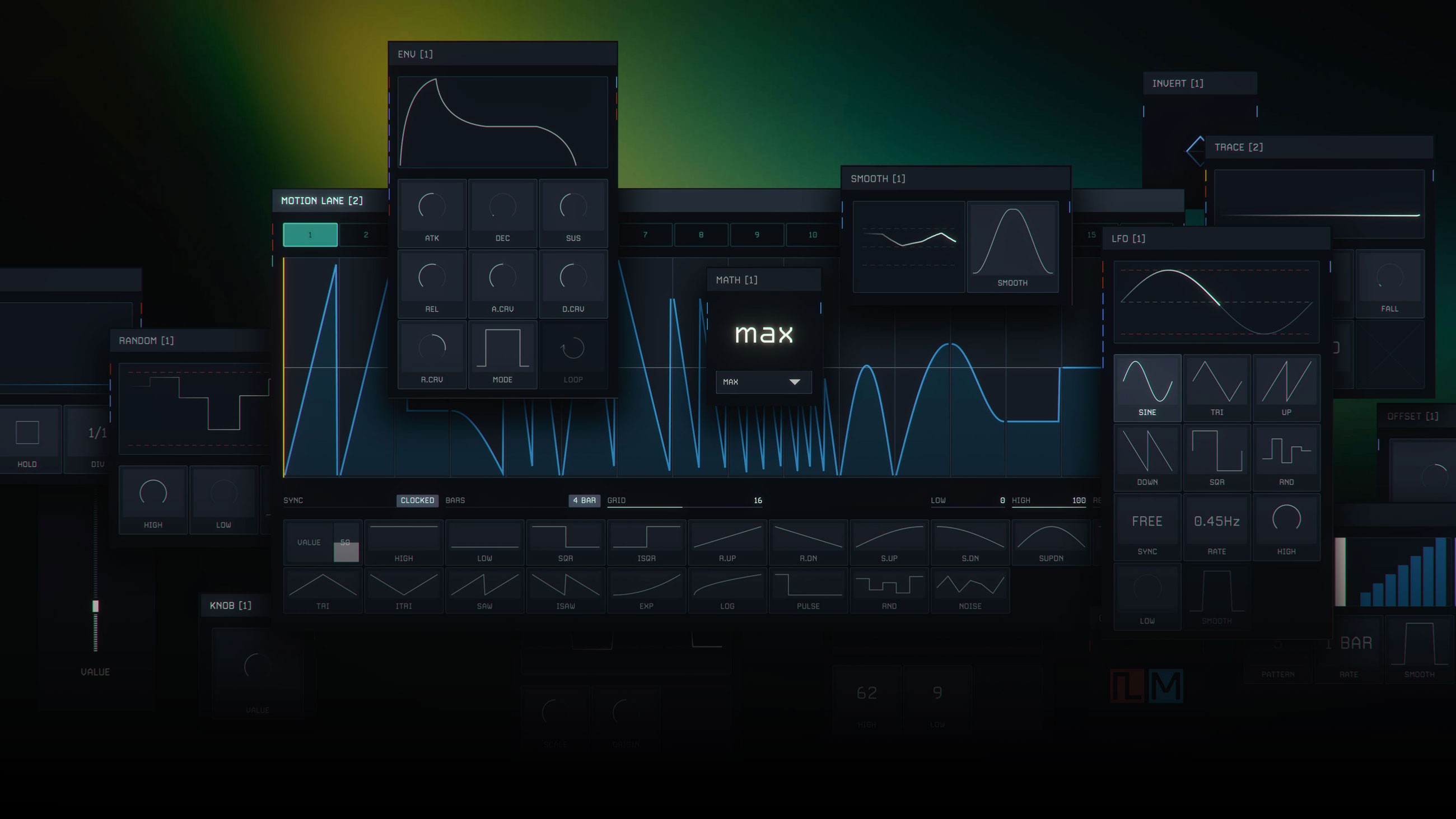
CV sources, shapers, and utilities that bring movement and life to your patches. Without modulation everything is static. These modules make parameters move, breathe, and react.
Sources — modules that generate CV from nothing:
LFO: 6 waveforms (sine/tri/saw/square/random), clock sync, adjustable bounds, 9 random CV outs.
KNOB: Manual fixed CV value, set it and forget it.
SLIDER: ARP-style vertical fader for real-time performance control.
RANDOM MOD: Random CV within adjustable bounds, gate-triggered or free-running.
STROBE: Trance gate patterns as CV, 8 presets synced to tempo.
TRACE: Envelope follower, turns audio amplitude into CV.
Envelopes & sequenced modulation:
ENVELOPE: ADSR with per-stage curve control, gate/trigger/loop modes.
MOTION LANE: Segment-based modulation editor. Draw curves visually, 32 segments, 16 patterns.
Modules that modify existing CV:
SMOOTH: Slew limiter with independent rise/fall times.
SCALE MOD: Expands or compresses CV around an adjustable pivot point.
OFFSET: Adds bipolar offset (-100% to +100%) to shift CV up or down.
TRIM: Attenuates CV, volume knob for modulation.
INVERT: Flips CV polarity (output = 1 - input).
HOLD: Sample & hold. Freezes CV on trigger, with free/clocked modes.
MATH: Arithmetic on two CVs: add/subtract/multiply/difference/min/max/average.
Converters:
GATE TO MOD: Converts gate on/off into 0/1 CV.
Modulation
CV sources, shapers, and utilities that bring movement and life to your patches. Without modulation everything is static. These modules make parameters move, breathe, and react.
Sources — modules that generate CV from nothing:
LFO: 6 waveforms (sine/tri/saw/square/random), clock sync, adjustable bounds, 9 random CV outs.
KNOB: Manual fixed CV value, set it and forget it.
SLIDER: ARP-style vertical fader for real-time performance control.
RANDOM MOD: Random CV within adjustable bounds, gate-triggered or free-running.
STROBE: Trance gate patterns as CV, 8 presets synced to tempo.
TRACE: Envelope follower, turns audio amplitude into CV.
Envelopes & sequenced modulation:
ENVELOPE: ADSR with per-stage curve control, gate/trigger/loop modes.
MOTION LANE: Segment-based modulation editor. Draw curves visually, 32 segments, 16 patterns.
Modules that modify existing CV:
SMOOTH: Slew limiter with independent rise/fall times.
SCALE MOD: Expands or compresses CV around an adjustable pivot point.
OFFSET: Adds bipolar offset (-100% to +100%) to shift CV up or down.
TRIM: Attenuates CV, volume knob for modulation.
INVERT: Flips CV polarity (output = 1 - input).
HOLD: Sample & hold. Freezes CV on trigger, with free/clocked modes.
MATH: Arithmetic on two CVs: add/subtract/multiply/difference/min/max/average.
Converters:
GATE TO MOD: Converts gate on/off into 0/1 CV.
Trigger/Gate
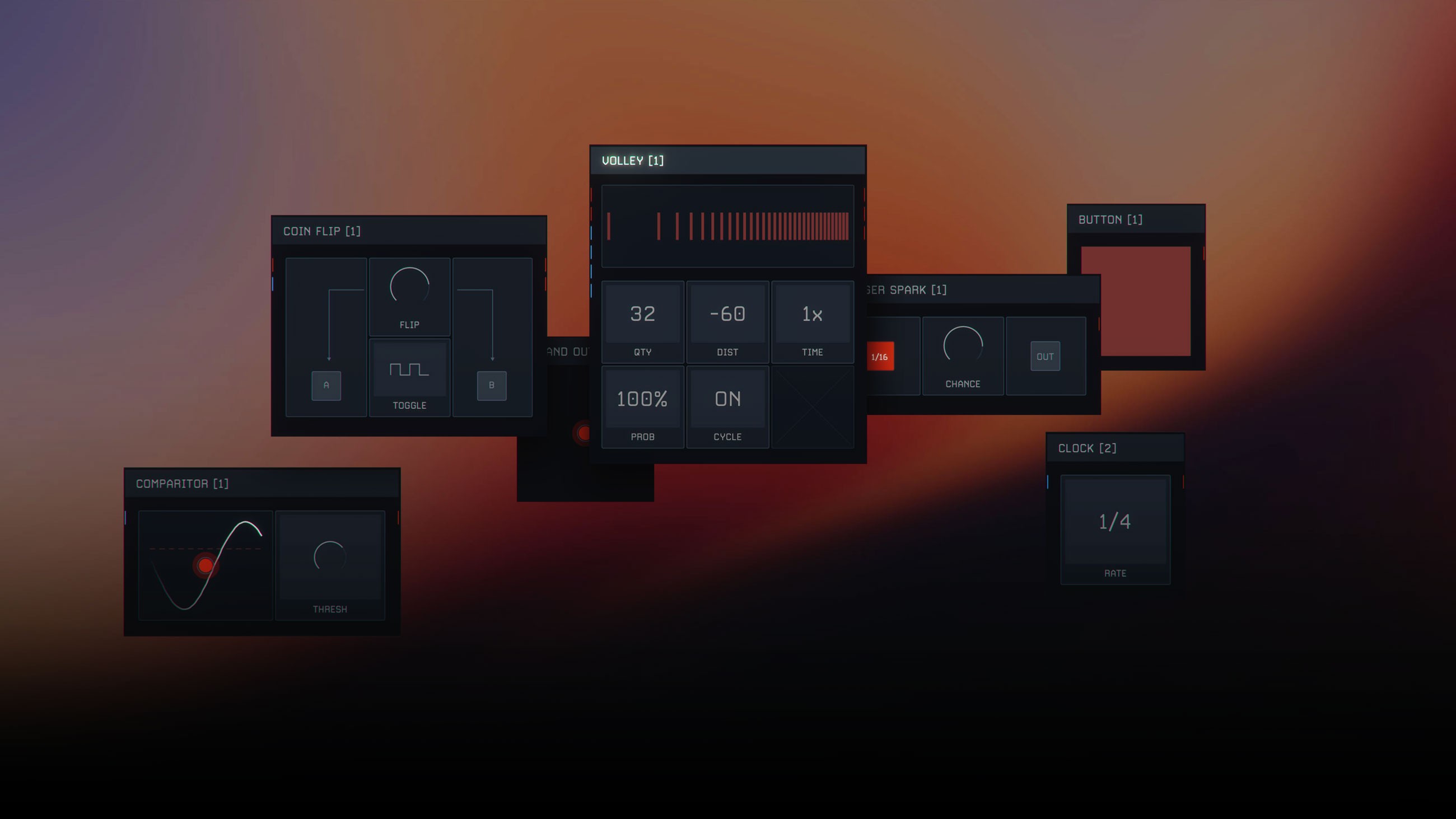
Gate and trigger modules. The clock sources, sequencers, and routing tools that control timing across your entire patch. If modulation is the breath, triggers are the heartbeat.
Timing sources:
CLOCK: Master tempo divider, 13 rates from 8-bar to 1/16T. The heartbeat of every patch.
BUTTON: Manual gate. Click it, gate goes high, release it, gate goes low.
TRANSPORT: Outputs gate high while the host DAW is playing.
Trigger generators:
TRIGGER SPARK: Random trigger generator. CHANCE knob = divider + probability in one.
VOLLEY: Burst trigger generator. One gate in, rapid-fire burst out.
Trigger routing & conversion:
COIN FLIP: Bernoulli gate. Probability routes triggers to output A or B.
COMPARITOR: CV threshold to gate. Fires gate when CV exceeds threshold.
IN AND OUT: Gate pass-through with LED indicator for visual debugging.
Trigger/Gate
Gate and trigger modules. The clock sources, sequencers, and routing tools that control timing across your entire patch. If modulation is the breath, triggers are the heartbeat.
Timing sources:
CLOCK: Master tempo divider, 13 rates from 8-bar to 1/16T. The heartbeat of every patch.
BUTTON: Manual gate. Click it, gate goes high, release it, gate goes low.
TRANSPORT: Outputs gate high while the host DAW is playing.
Trigger generators:
TRIGGER SPARK: Random trigger generator. CHANCE knob = divider + probability in one.
VOLLEY: Burst trigger generator. One gate in, rapid-fire burst out.
Trigger routing & conversion:
COIN FLIP: Bernoulli gate. Probability routes triggers to output A or B.
COMPARITOR: CV threshold to gate. Fires gate when CV exceeds threshold.
IN AND OUT: Gate pass-through with LED indicator for visual debugging.
Sound Sources
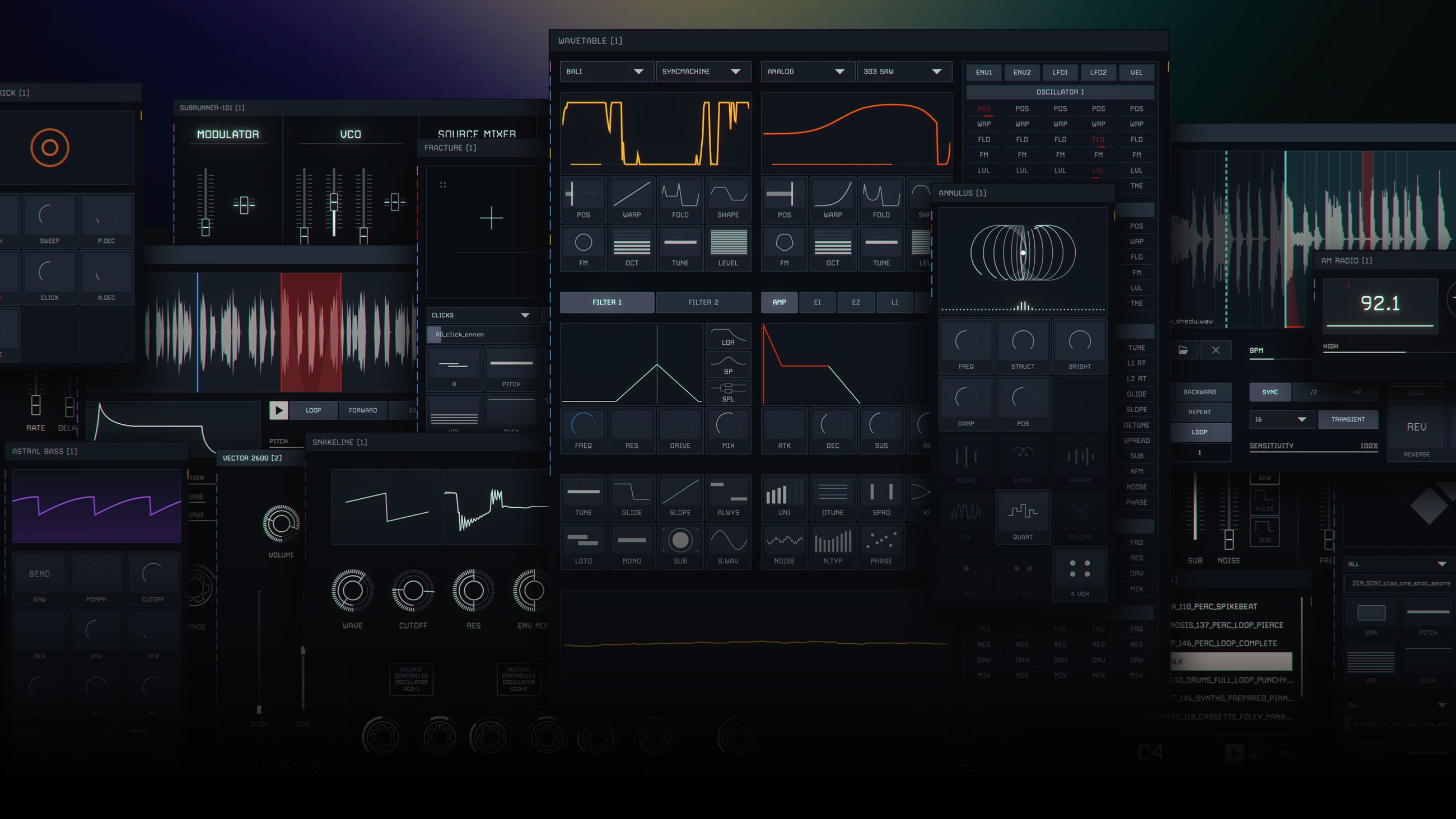
The voices of Modular Fiasco: synthesizers, samplers, and sound generators that turn MIDI and gate signals into actual audio.
Classic synth emulations:
AURORA-60: Roland Juno-60. Warm, lush pads & chorus. The friendly one.
SUBRUNNER-101: Roland SH-101. Punchy, direct bass & leads. The workhorse.
SNAKELINE: Roland TB-303. Squelchy acid bass. THE acid machine.
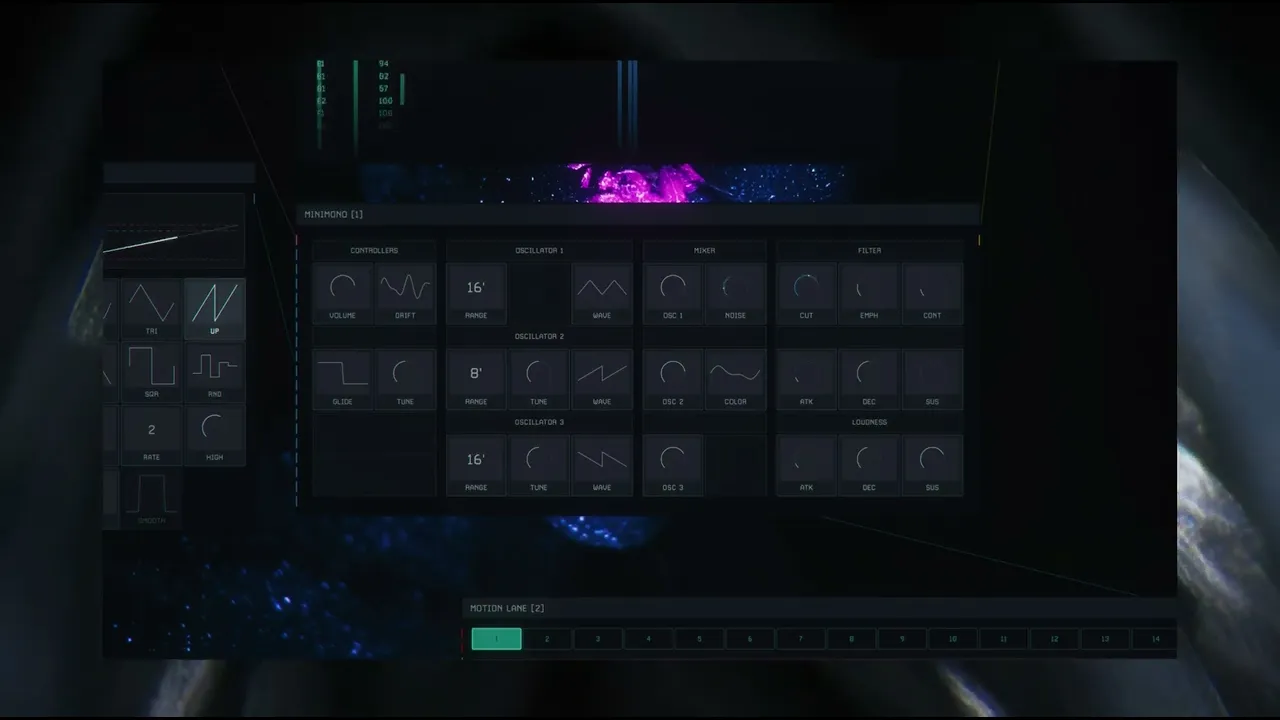
MINIMONO: Moog Minimoog. Fat 3-osc bass & leads. The classic.
COSMIC-8: Roland Jupiter-8. Massive dual-osc pads & leads. The king.
GRINDER-20: Korg MS-20. Aggressive, screaming dual filters. The raw one.
IMPERIUM-80: Yamaha CS-80. Dual-layer cinematic expressiveness. The beast.
VECTOR 2600: ARP 2600. Semi-modular, 3 VCOs, ring mod. The sci-fi synth.
Modern synthesis:
WAVETABLE: Dual wavetable oscillators, dual filters, 5-slot mod matrix, unison — the most complex source.
ASTRAL BASS: 5 morphable saw-variant waveforms, dedicated bass synth with filter envelope.
ANNULUS: Mutable Instruments Rings. Physical modeling resonator, 6 models.
Samplers & Drums:
TRUMMIS: 5-voice drum sampler (kick/snare/hihat/OH/perc), 6 audio outs, kick ducking.
FRACTURE: 5-voice glitch sampler, same architecture as TRUMMIS but for chaos.
PIZZA: Slice sample chopper with per-slice modulation. Breakbeat central.
LOOPER: 4-voice polyphonic sample player with loop points, crossfade, and pitch.
SAMPLE: Simple one-shot sample playback. Just trigger and go.
AM RADIO: 10 virtual AM radio stations with static and tuning noise.
COSMIC KICK: Dedicated kick drum synthesizer with pitch sweep and drive.
The classic emulations cover the golden age of analog. From the Juno's lush chorus to the MS-20's screaming filter to the 303's acid squelch. WAVETABLE is the modern powerhouse with its dual oscillators, mod matrix, and wavetable scanning. For samples, TRUMMIS and FRACTURE are your drum machines, PIZZA chops loops into sliceable breakbeats, and LOOPER turns any audio file into a playable instrument. ANNULUS bring physical modeling for sounds that don't come from traditional oscillators.
Sound Sources
The voices of Modular Fiasco: synthesizers, samplers, and sound generators that turn MIDI and gate signals into actual audio.
Classic synth emulations:
AURORA-60: Roland Juno-60. Warm, lush pads & chorus. The friendly one.
SUBRUNNER-101: Roland SH-101. Punchy, direct bass & leads. The workhorse.
SNAKELINE: Roland TB-303. Squelchy acid bass. THE acid machine.
MINIMONO: Moog Minimoog. Fat 3-osc bass & leads. The classic.
COSMIC-8: Roland Jupiter-8. Massive dual-osc pads & leads. The king.
GRINDER-20: Korg MS-20. Aggressive, screaming dual filters. The raw one.
IMPERIUM-80: Yamaha CS-80. Dual-layer cinematic expressiveness. The beast.
VECTOR 2600: ARP 2600. Semi-modular, 3 VCOs, ring mod. The sci-fi synth.
Modern synthesis:
WAVETABLE: Dual wavetable oscillators, dual filters, 5-slot mod matrix, unison — the most complex source.
ASTRAL BASS: 5 morphable saw-variant waveforms, dedicated bass synth with filter envelope.
ANNULUS: Mutable Instruments Rings. Physical modeling resonator, 6 models.
Samplers & Drums:
TRUMMIS: 5-voice drum sampler (kick/snare/hihat/OH/perc), 6 audio outs, kick ducking.
FRACTURE: 5-voice glitch sampler, same architecture as TRUMMIS but for chaos.
PIZZA: Slice sample chopper with per-slice modulation. Breakbeat central.
LOOPER: 4-voice polyphonic sample player with loop points, crossfade, and pitch.
SAMPLE: Simple one-shot sample playback. Just trigger and go.
AM RADIO: 10 virtual AM radio stations with static and tuning noise.
COSMIC KICK: Dedicated kick drum synthesizer with pitch sweep and drive.
The classic emulations cover the golden age of analog. From the Juno's lush chorus to the MS-20's screaming filter to the 303's acid squelch. WAVETABLE is the modern powerhouse with its dual oscillators, mod matrix, and wavetable scanning. For samples, TRUMMIS and FRACTURE are your drum machines, PIZZA chops loops into sliceable breakbeats, and LOOPER turns any audio file into a playable instrument. ANNULUS bring physical modeling for sounds that don't come from traditional oscillators.
Audio FX
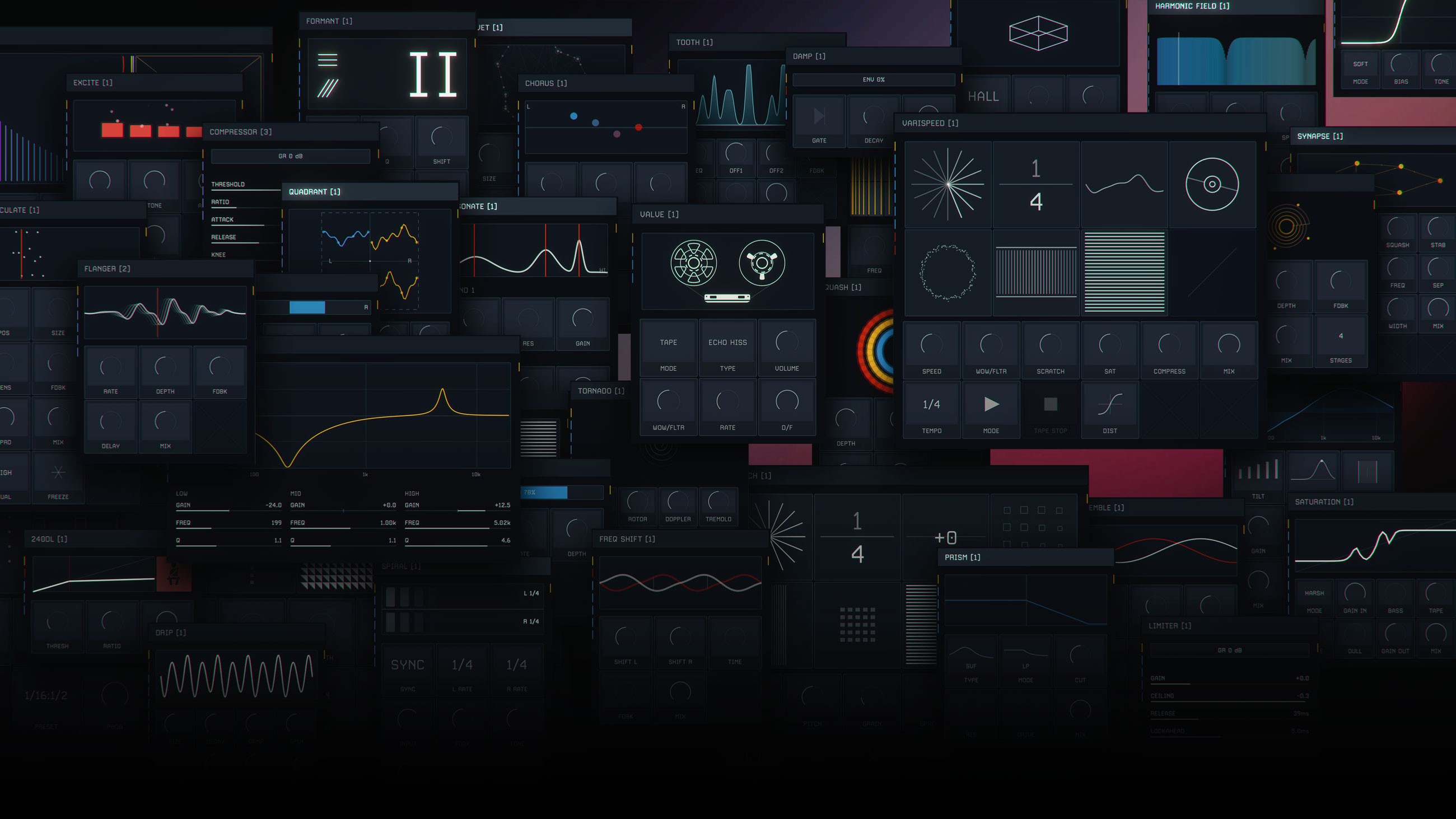
Effects processors for shaping, mangling, and spatializing your audio. 35 modules covering everything from subtle warmth to complete sonic destruction.
Reverb:
DATTORRO: Plate reverb — diffusion, freeze, tank filters. The full-featured one.
ROOM: Room simulation — 4 shapes (Small/Medium/Hall/Cathedral), 3-band EQ on tail.
VELVET: FDN algorithmic — Modulated allpass diffusion, smooth & enveloping.
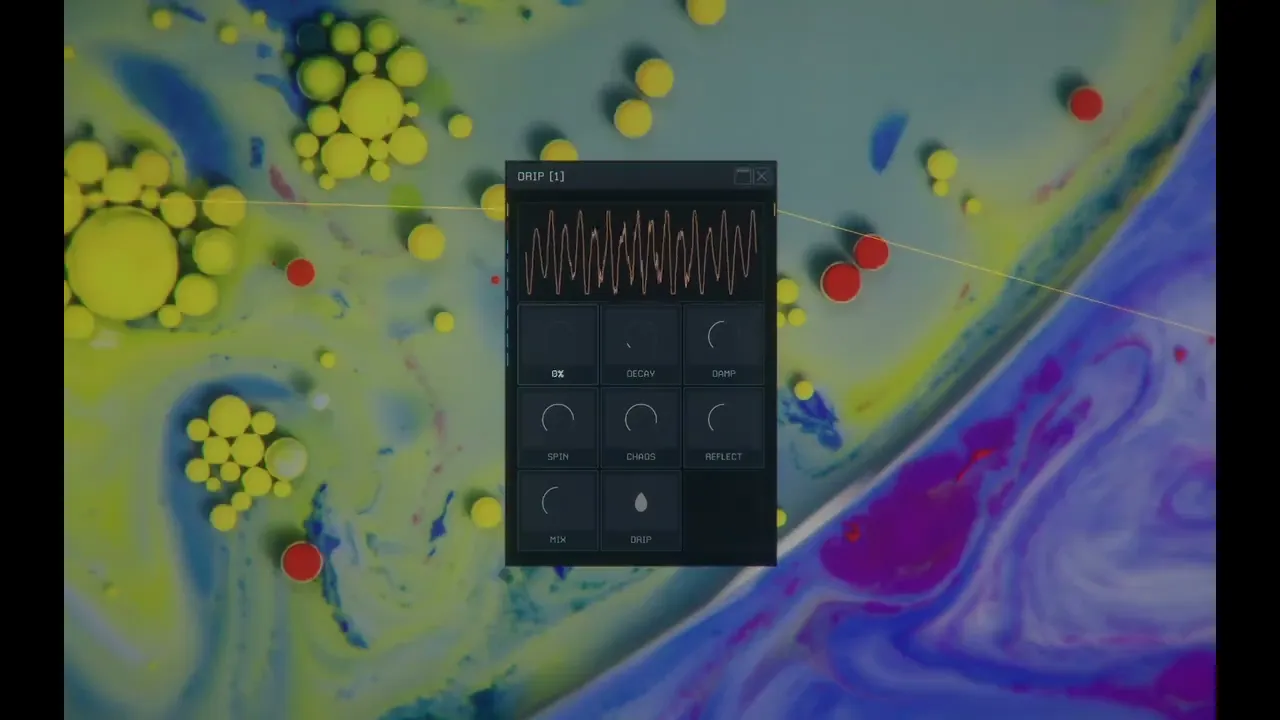
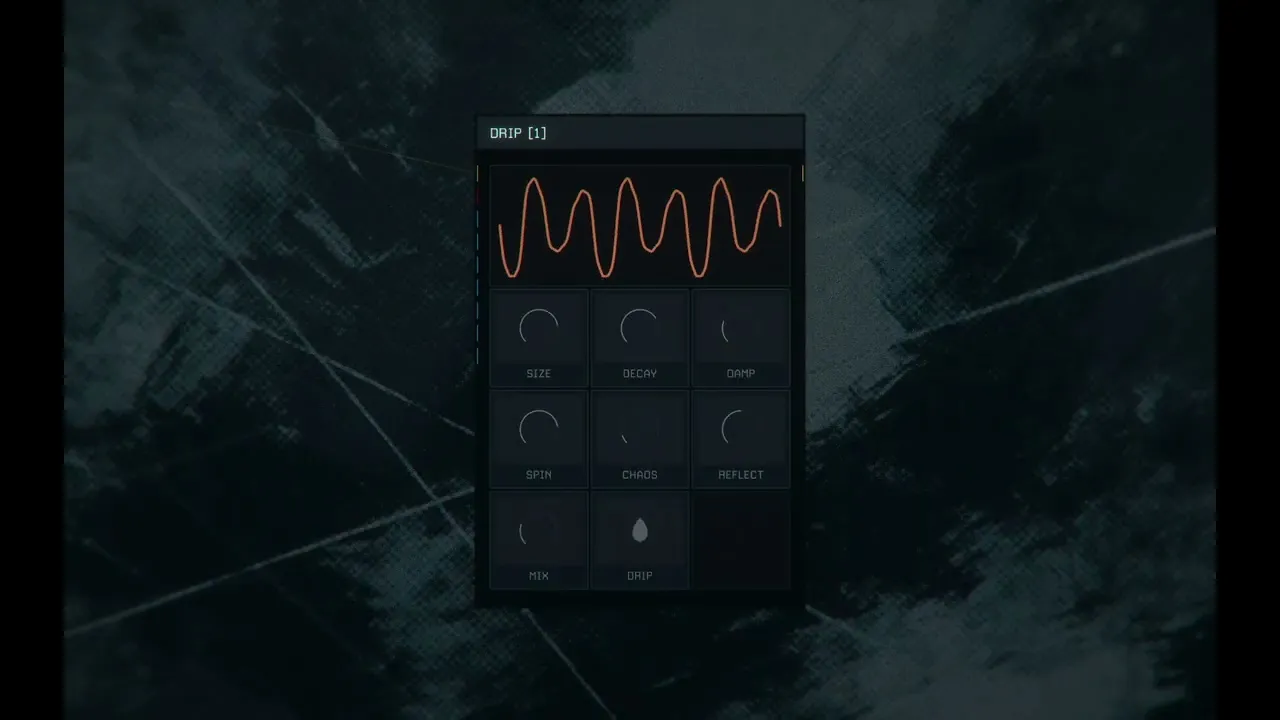
DRIP: Spring reverb — gate-triggered drip that shakes the springs, lo-fi dub vibes.
Delay:
SPIRAL: Stereo tape delay — independent L/R times, wobble, tone, noise.
FREQ SHIFT: Frequency shifter with built-in delay — cascading pitch spirals.
Filters:
PRISM: 4 topologies (SVF/Ladder/Diode/Dirty) x 3 modes, drive, response curve.
COMB: Comb filter — 14 harmonic peaks, spread, polarity, Karplus-Strong territory.
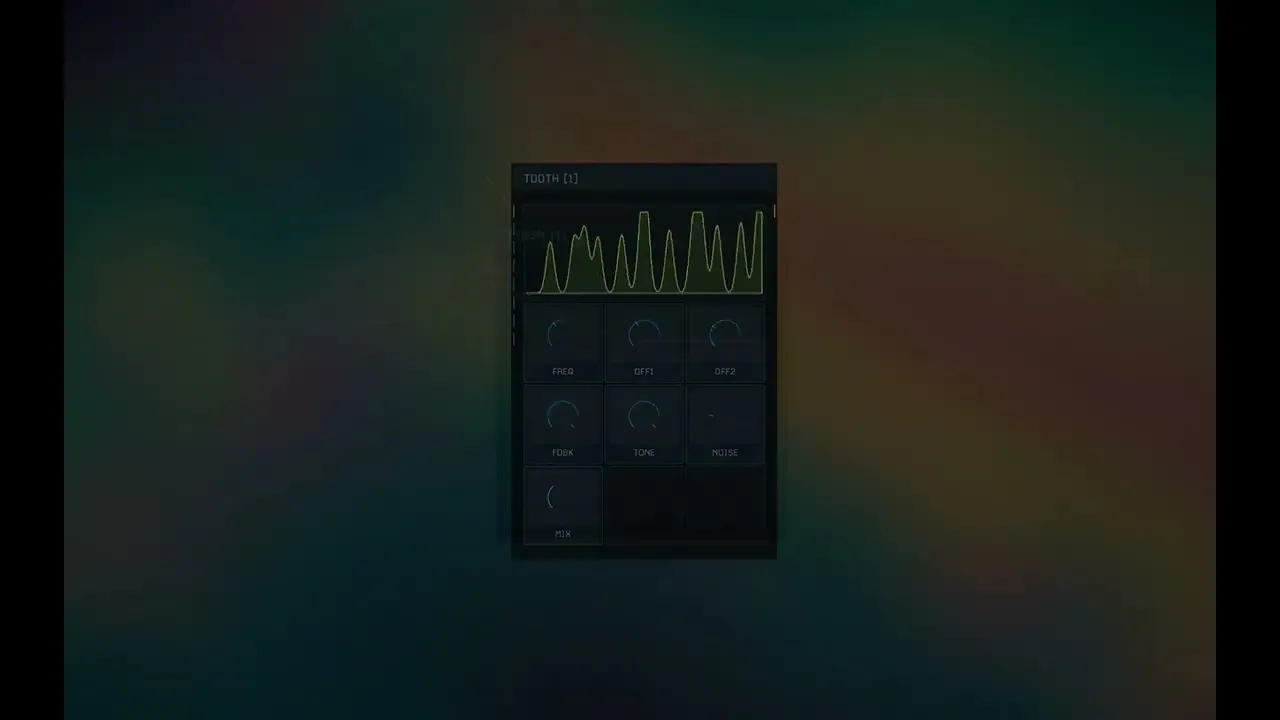
TOOTH: Simple comb — less params than COMB, more immediate.
FORMANT: Vowel filter — 5 voice models, A-E-I-O-U morphing, talking synths.
RESONATE: 3-band resonator — three tunable resonant peaks, 4 filter modes.
CHROMA: Spectral STFT filter — tilt/center/width/warp/gate in the frequency domain.
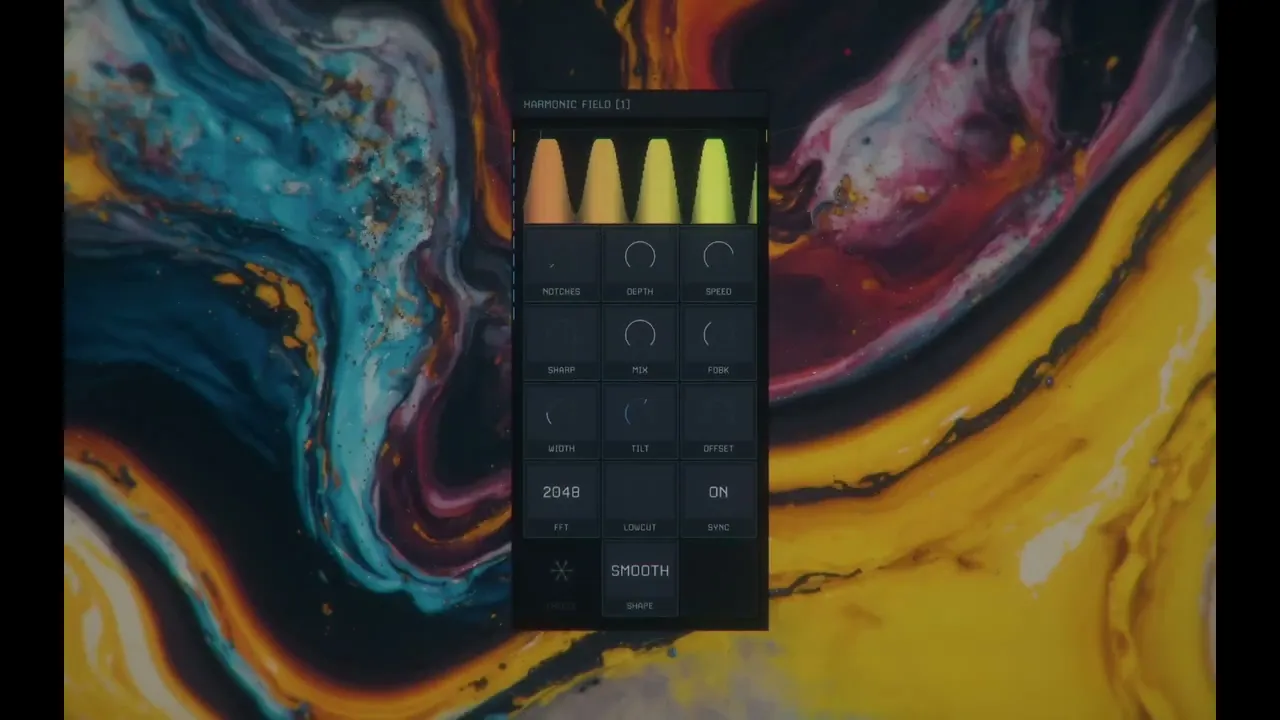
HARMONIC FIELD: FFT spectral comb — 2-122 sweeping notches, frequency-domain phaser.
DAMP: Lowpass gate — Buchla-style vactrol LPG, coupled filter+VCA decay.
Distortion & Saturation:
DISTORTION: 9 waveshaper algorithms with transfer curve display and bias control.
240DL: Distortion/compression hybrid with threshold/ratio and flip mode.
SATURATION:Tape saturation — 4 modes (Gently to Harsh), bass boost, noise, dull.
SYNAPSE: Neural distortion — non-linear, unpredictable harmonic generation.
EXCITE: Harmonic enhancer — Aural Exciter-style presence boost.
Dynamics:
COMPRESSOR: Feed-forward soft-knee — clean, transparent, Giannoulis algorithm.
SQUASH: OTT multiband — 3-band upward+downward compression, the EDM sound.
LIMITER: Brickwall lookahead — ceiling protection, last in the chain.
EQ: 3-band parametric with real-time FFT spectrum analyzer.
Modulation FX:
CHORUS: 4-voice stereo chorus — classic widening with tone shaping.
ENSEMBLE: BBD chorus — 4 chip types, dual LFOs, vintage analog character.
PHASER: All-pass phaser — 2-12 stages, classic swoosh.
FLANGER: Stereo flanger — jet-engine sweep, metallic resonance.
TREMOR: Stereo tremolo — sine/tri/square morph, tempo sync.
ORBIT: Stereo auto-panner — same architecture as TREMOR, moves sound in stereo.
TONE TORNADO: Rotary speaker — Leslie cabinet with horn/drum simulation.
QUADRANT: Pitch-tracked ring modulator — metallic, bell-like, robotic tones.
Granular & Time:
PARTICULATE: Granular processor (Clouds-inspired) — 4 modes, freeze, grain clouds.
STRETCH: Granular time-stretch — independent speed and pitch, freeze.
STUTTER: Buffer repeat/glitch — 19 presets, probability, tape stop, the glitch tool.
VARISPEED: Tape variable speed — wow, flutter, scratch, tape stop.
Texture:
VALVE: Analog noise loops — tape hiss/vinyl crackle with duck/follow.
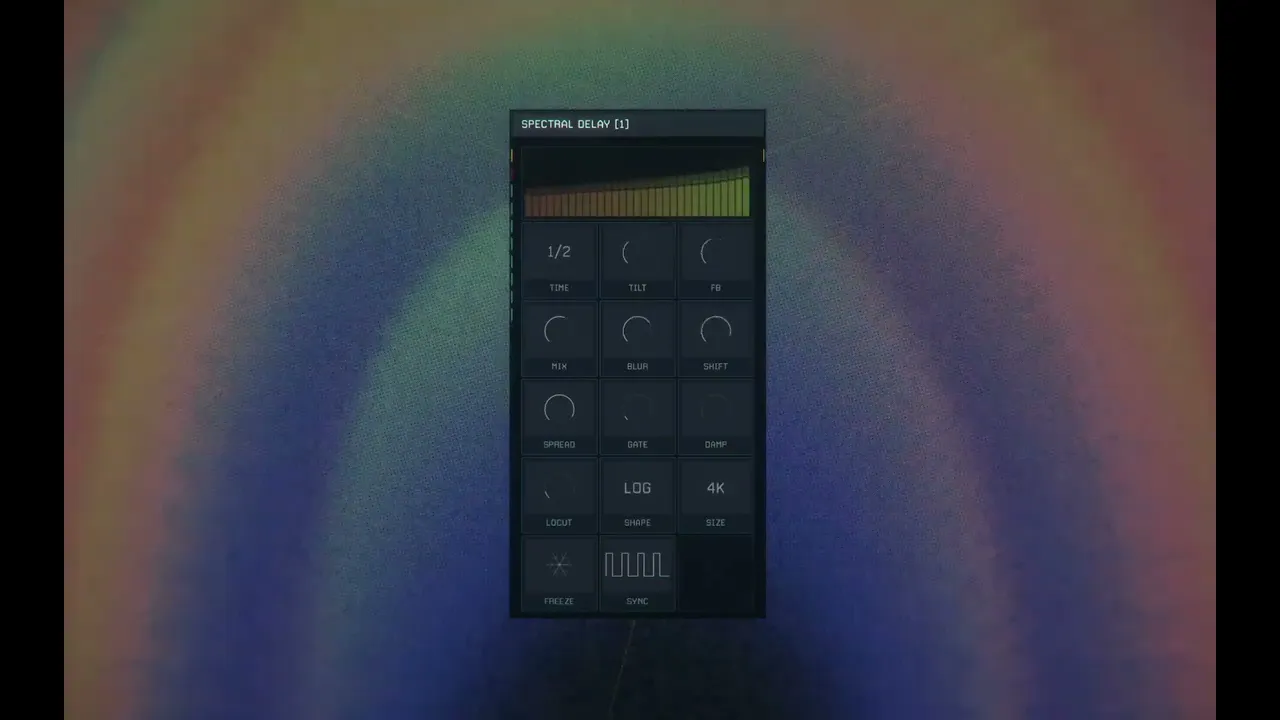
Four reverbs cover every vibe. DATTORRO for lush plates, ROOM for realistic spaces, VELVET for smooth FDN ambience, and DRIP for splattery spring dub. SPIRAL is the go-to delay with its tape character, while FREQ SHIFT creates alien pitch-cascading echoes. Filters range from the dead simple (FILTER) to the deeply weird (CHROMA's spectral FFT processing, HARMONIC FIELD's 122-notch phasing). Five flavors of dirt cover subtle tape warmth (SATURATION) through to 9-algorithm waveshaping (DISTORTION). SQUASH delivers the OTT sound that modern electronic music runs on. The modulation effects cover all the classics: chorus, phaser, flanger, tremolo, plus TONE TORNADO's Leslie and QUADRANT's ring mod for the weird shit. PARTICULATE, STRETCH, STUTTER, and VARISPEED handle granular and time-based mangling.
Audio FX
Effects processors for shaping, mangling, and spatializing your audio. 35 modules covering everything from subtle warmth to complete sonic destruction.
Reverb:
DATTORRO: Plate reverb — diffusion, freeze, tank filters. The full-featured one.
ROOM: Room simulation — 4 shapes (Small/Medium/Hall/Cathedral), 3-band EQ on tail.
VELVET: FDN algorithmic — Modulated allpass diffusion, smooth & enveloping.
DRIP: Spring reverb — gate-triggered drip that shakes the springs, lo-fi dub vibes.
Delay:
SPIRAL: Stereo tape delay — independent L/R times, wobble, tone, noise.
FREQ SHIFT: Frequency shifter with built-in delay — cascading pitch spirals.
Filters:
PRISM: 4 topologies (SVF/Ladder/Diode/Dirty) x 3 modes, drive, response curve.
COMB: Comb filter — 14 harmonic peaks, spread, polarity, Karplus-Strong territory.
TOOTH: Simple comb — less params than COMB, more immediate.
FORMANT: Vowel filter — 5 voice models, A-E-I-O-U morphing, talking synths.
RESONATE: 3-band resonator — three tunable resonant peaks, 4 filter modes.
CHROMA: Spectral STFT filter — tilt/center/width/warp/gate in the frequency domain.
HARMONIC FIELD: FFT spectral comb — 2-122 sweeping notches, frequency-domain phaser.
DAMP: Lowpass gate — Buchla-style vactrol LPG, coupled filter+VCA decay.
Distortion & Saturation:
DISTORTION: 9 waveshaper algorithms with transfer curve display and bias control.
240DL: Distortion/compression hybrid with threshold/ratio and flip mode.
SATURATION:Tape saturation — 4 modes (Gently to Harsh), bass boost, noise, dull.
SYNAPSE: Neural distortion — non-linear, unpredictable harmonic generation.
EXCITE: Harmonic enhancer — Aural Exciter-style presence boost.
Dynamics:
COMPRESSOR: Feed-forward soft-knee — clean, transparent, Giannoulis algorithm.
SQUASH: OTT multiband — 3-band upward+downward compression, the EDM sound.
LIMITER: Brickwall lookahead — ceiling protection, last in the chain.
EQ: 3-band parametric with real-time FFT spectrum analyzer.
Modulation FX:
CHORUS: 4-voice stereo chorus — classic widening with tone shaping.
ENSEMBLE: BBD chorus — 4 chip types, dual LFOs, vintage analog character.
PHASER: All-pass phaser — 2-12 stages, classic swoosh.
FLANGER: Stereo flanger — jet-engine sweep, metallic resonance.
TREMOR: Stereo tremolo — sine/tri/square morph, tempo sync.
ORBIT: Stereo auto-panner — same architecture as TREMOR, moves sound in stereo.
TONE TORNADO: Rotary speaker — Leslie cabinet with horn/drum simulation.
QUADRANT: Pitch-tracked ring modulator — metallic, bell-like, robotic tones.
Granular & Time:
PARTICULATE: Granular processor (Clouds-inspired) — 4 modes, freeze, grain clouds.
STRETCH: Granular time-stretch — independent speed and pitch, freeze.
STUTTER: Buffer repeat/glitch — 19 presets, probability, tape stop, the glitch tool.
VARISPEED: Tape variable speed — wow, flutter, scratch, tape stop.
Texture:
VALVE: Analog noise loops — tape hiss/vinyl crackle with duck/follow.
Four reverbs cover every vibe. DATTORRO for lush plates, ROOM for realistic spaces, VELVET for smooth FDN ambience, and DRIP for splattery spring dub. SPIRAL is the go-to delay with its tape character, while FREQ SHIFT creates alien pitch-cascading echoes. Filters range from the dead simple (FILTER) to the deeply weird (CHROMA's spectral FFT processing, HARMONIC FIELD's 122-notch phasing). Five flavors of dirt cover subtle tape warmth (SATURATION) through to 9-algorithm waveshaping (DISTORTION). SQUASH delivers the OTT sound that modern electronic music runs on. The modulation effects cover all the classics: chorus, phaser, flanger, tremolo, plus TONE TORNADO's Leslie and QUADRANT's ring mod for the weird shit. PARTICULATE, STRETCH, STUTTER, and VARISPEED handle granular and time-based mangling.
Audio
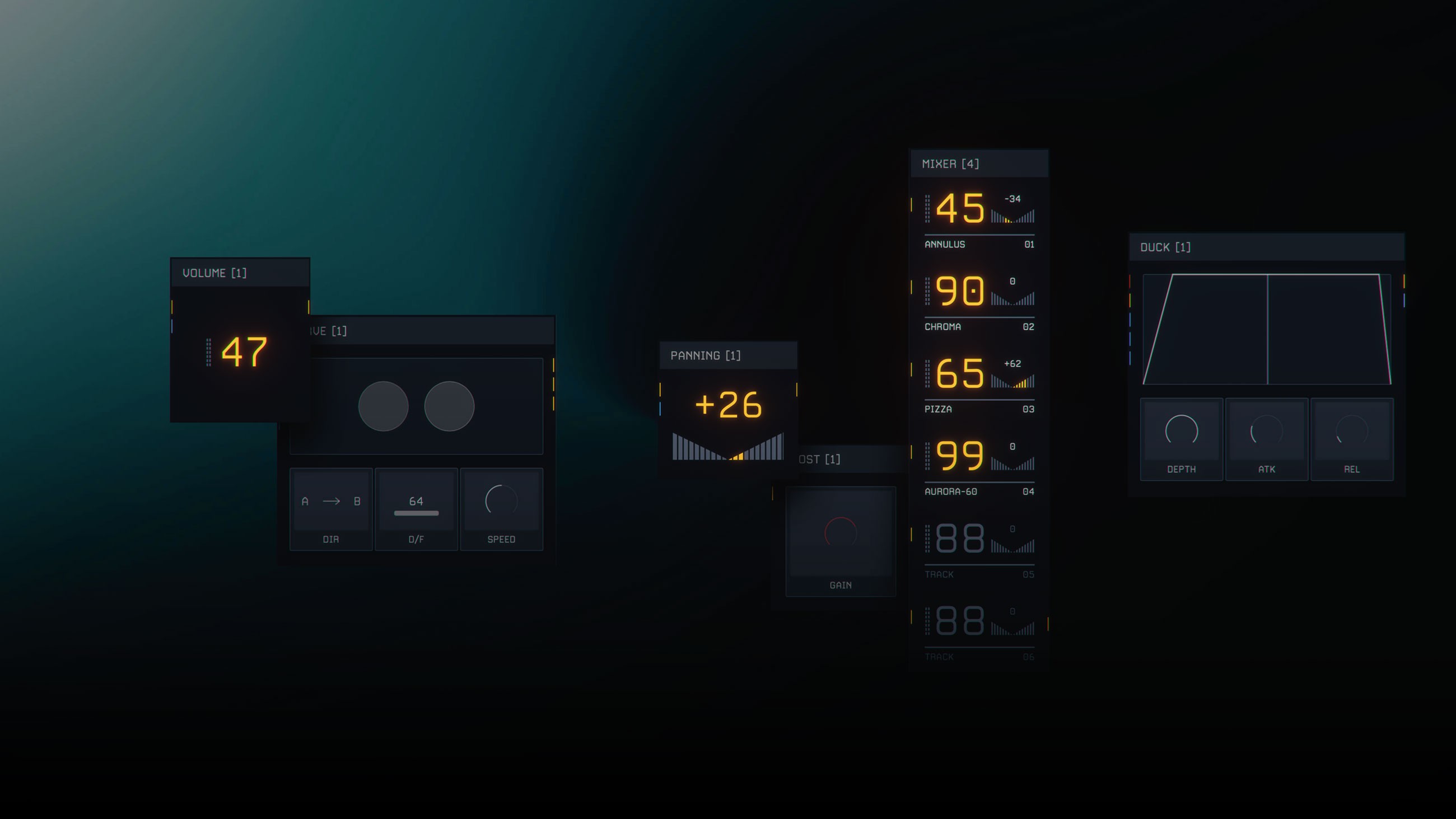
Mixing, routing, level control, and dynamics. The plumbing that holds your patch together.
MIXER: 6-channel mixer with per-channel volume, pan, and metering. You need at least one.
VOLUME: Simple gain attenuator, CV-controllable as a VCA.
BOOST: Gain amplifier 100-400%, for when VOLUME isn't enough.
PANNING: Stereo placement with CV control.
DUCK: Classic sidechain compressor, signal ducks when sidechain is loud.
CARVE: Sidechain duck/follow between two signals with reversible direction and 3 outputs.
MIXER is the one you'll use in every single patch. 6 channels with source name display so you always know what's plugged in. VOLUME doubles as a VCA when you feed its CV input with an envelope. BOOST pushes past unity gain when something needs to be louder than loud. DUCK is your standard sidechain pumping, while CARVE does the same thing but fancier. Bidirectional duck/follow between two signals with separate A, B, and mix outputs.
Audio
Mixing, routing, level control, and dynamics. The plumbing that holds your patch together.
MIXER: 6-channel mixer with per-channel volume, pan, and metering. You need at least one.
VOLUME: Simple gain attenuator, CV-controllable as a VCA.
BOOST: Gain amplifier 100-400%, for when VOLUME isn't enough.
PANNING: Stereo placement with CV control.
DUCK: Classic sidechain compressor, signal ducks when sidechain is loud.
CARVE: Sidechain duck/follow between two signals with reversible direction and 3 outputs.
MIXER is the one you'll use in every single patch. 6 channels with source name display so you always know what's plugged in. VOLUME doubles as a VCA when you feed its CV input with an envelope. BOOST pushes past unity gain when something needs to be louder than loud. DUCK is your standard sidechain pumping, while CARVE does the same thing but fancier. Bidirectional duck/follow between two signals with separate A, B, and mix outputs.
Utilities
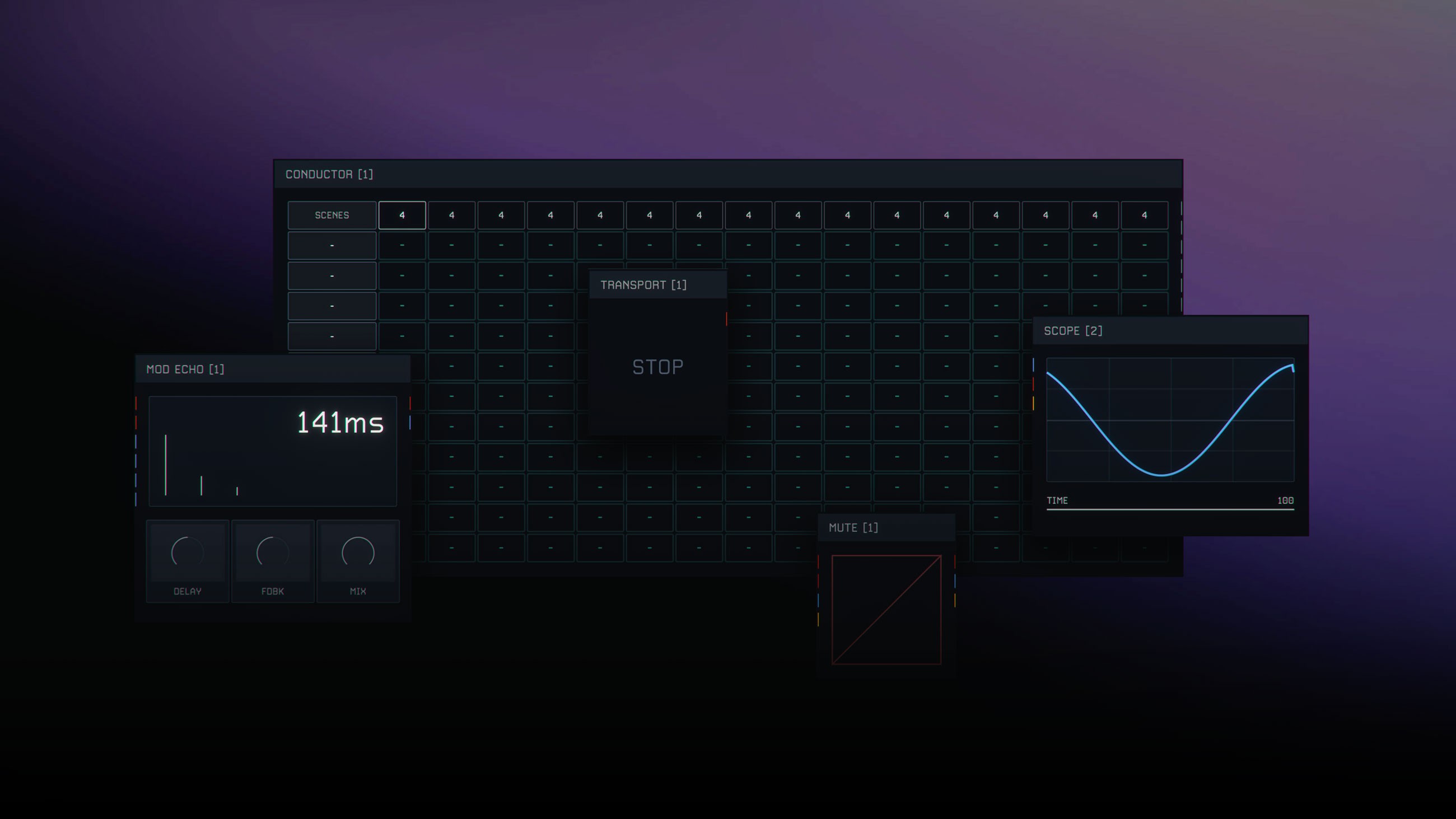
Arrangement, monitoring, recording, and the weird stuff that doesn't fit anywhere else but you'd be lost without.
Arrangement:
CONDUCTOR: Song arranger. 16 scenes with bar lengths, links to 11 sequencer tracks for pattern changes.
MUTE: Signal mute for audio/CV/gate, gate-triggered or manual toggle.
TRANSPORT: Outputs gate high while the host DAW is playing.
Signal tools:
MOD ECHO: CV/Gate delay. Free-running or clock-synced, creates echoed modulation.
Monitoring:
SCOPE: Oscilloscope, a real-time waveform display for CV, gate, and audio.
RECORDER: Audio recorder. WAV export, 5 min max, pass-through.
Utilities
Arrangement, monitoring, recording, and the weird stuff that doesn't fit anywhere else but you'd be lost without.
Arrangement:
CONDUCTOR: Song arranger. 16 scenes with bar lengths, links to 11 sequencer tracks for pattern changes.
MUTE: Signal mute for audio/CV/gate, gate-triggered or manual toggle.
TRANSPORT: Outputs gate high while the host DAW is playing.
Signal tools:
MOD ECHO: CV/Gate delay. Free-running or clock-synced, creates echoed modulation.
Monitoring:
SCOPE: Oscilloscope, a real-time waveform display for CV, gate, and audio.
RECORDER: Audio recorder. WAV export, 5 min max, pass-through.